
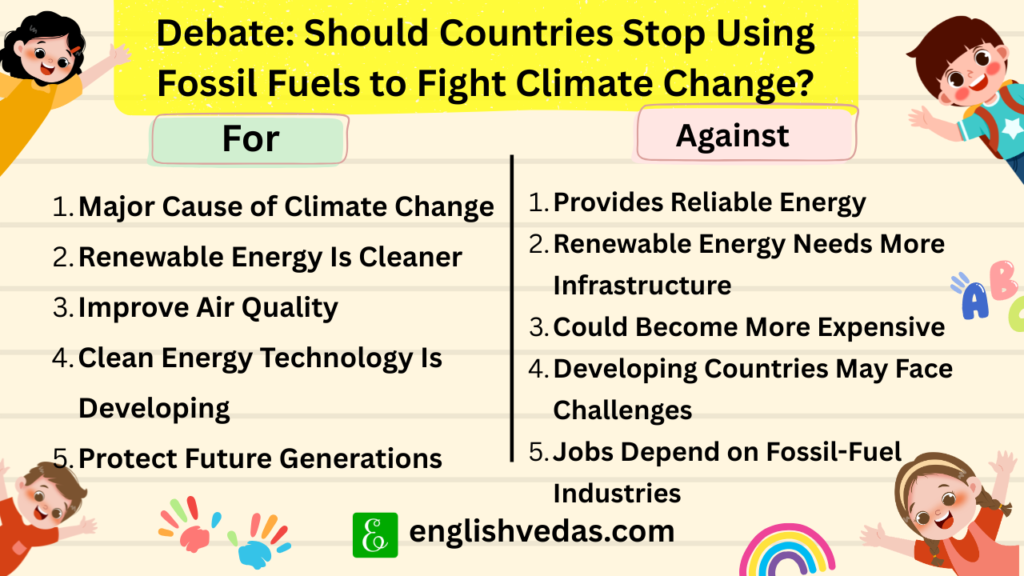
Should countries stop using fossil fuels? This is a compelling argument. Fossil fuels remain a reliable energy source. But the important question is whether developing countries are ready for this kind of rapid transition. Let us discuss the points for and against the debate topic.
Points Against the Motion (Should Countries Stop Using Fossil Fuels to Fight Climate Change?)
- Fossil Fuels Still Provide Reliable Energy – Coal, oil, and natural gas can provide electricity and energy when needed. Whatever a person wears, for example, a rain jacket, is a petro chemical which is derived from oil. Fingernail polish is a petrochemical. A pink hair dye is not natural either. Plastic is an oil product. Production of an iPhone requires fossil fuels and mined minerals. Fossil fuel is delivered to people cleanly and conveniently by fossil fuels themselves. 60% of all the power plants in America are fossil fuel-driven. Fossil fuels serve two purposes: power production and material production. 40%of each barrel of oil goes to gasoline production, which is a kind of fuel. Petrochemicals are a fancy word for products derived from oil. Hence, one cannot depend on renewable energy, which uses wind and sunlight.
- Renewable Energy Needs More Infrastructure – Renewable energy like wind and solar has a hidden infrastructure problem. It requires new power plants, transmission lines, batteries, and storage systems. The power grid, which carries electricity to homes and businesses, wasn’t designed for wind and solar. Renewables have become a larger part of the power supply, but the grid infrastructure hasn’t kept up.
- Energy Could Become More Expensive – In most of the countries, energy costs would increase. They do not have affordable renewable alternatives. As less clean energy becomes available, prices will shoot up. Expensive batteries are needed for the storage of clean energy. The power that comes from the sun or wind is unstable, which requires a better grid system to handle it. Fossil fuels will run out in the future, and it is said that oil reserves will run out by 2052. Natural gas will run out by 2060.
- Developing Countries May Face Greater Challenges – Developing countries may face challenges because millions of people who live there need steady electricity, and the countries will not be able to build modern infrastructure. Such countries need inexpensive and dependable energy to expand industries, create jobs, and improve living standards. Power is needed to run schools and hospitals. Trucks and ships are used to move food to the market, and they are run by fuel. The absence of fossil fuels may result in food shortages.
- Millions of Jobs Depend on Fossil-Fuel Industries – Developing countries want industries to expand so that they can create more jobs. It will be difficult to stop using fossil fuels completely. Coal mining, oil production, and natural gas-related industries provide employment to millions. It will become necessary to create alternative employment before stopping the use of fossil fuels. A sudden transition could cause job losses unless alternative employment is created.
Points For the Motion
- Fossil Fuels Are a Major Cause of Climate Change – Burning fossil fuels leads to the emission of carbon dioxide. Carbon dioxide acts as a blanket around the Earth. The average global temperature increases, sea level rises, biodiversity loss, and species extinction. Oil spills have a devastating impact on our ecosystem. Hurricanes, wildfires, floods, and droughts occur due to global warming. The release of carbon dioxide and methane results in extreme weather conditions. Dangerous pollutants like sulphur dioxide, nitrogen oxides, and particulate matter cause respiratory illnesses, heart disease, and even premature death. Over 4 million people die each year due to air pollution. Oil spills in oceans, toxic waste in rivers, and fossil fuel extraction and transport pollute our water.
- Renewable Energy Is Cleaner – The energy produced by solar and wind does not emit greenhouse gases or air pollutants. Traditional power plants release toxic sulphur dioxide, nitrogen oxides, and fine particulate matter. The use of renewable energy leads to less pollution. Renewable energy is considered clean because it produces less green house gases. Such energy systems is cleaner and healthier.
- Reducing Fossil Fuels Can Improve Air Quality – Burning coal, oil, and gas releases pollutants that can contribute to poor air quality. Switching to cleaner energy can help create healthier communities. The use of fossil fuels comes at a devastating cost. Burning fossil fuels releases harmful pollutants like sulphur dioxide, nitrogen oxides, methane, and fine particulate matter into the air. This traps the heat in the atmosphere. When we use electric vehicles, it eliminates tailpipe emissions.
- Clean Energy Technology Is Developing Quickly – The clean energy revolution is just getting started. Picture floating wind farms, thin solar panels, and space-based solar power are on the cards. Clean energy development will create more jobs by 2030. Solar panels, wind turbines, batteries, and electric vehicles are becoming increasingly important parts of modern energy systems. Continuing the transition can encourage further innovation and investment. Some cutting-edge clean energy technologies include solar windows, vertical farming, ocean energy, electric vehicles, and artificial intelligence in energy management.
- Countries Need to Protect Future Generations – Climate change can affect food production, water supplies, ecosystems, and communities. Reducing dependence on fossil fuels today can help limit the risks faced by future generations. There should be policies to protect the workforce from the implications of the transition in energy usage. Countries should increase the use of renewables.
Reference:-
- https://www.youtube.com/watch?v=V1MLdoW4kf4
- https://www.youtube.com/watch?v=Sq-y-wiZduE
- https://www.youtube.com/watch?v=9BegxsqjCr8
Also Read:-
- Should Peaceful Protests Have More Legal Protection? | Debate
- Should Social Media Have a Minimum Age of 16? |Debate
- Can Money Buy Happiness? Debate with Arguments For and Against
- Can Artificial Intelligence Replace Human Intelligence?| Best Debate 2026
- Should Students Be Allowed to Use AI Tools for Assignments? | Pros and Cons | Debate

My name is Sukhjit Kaur, and I am an English educator with 17+ years of experience helping students master grammar and writing. Through EnglishVedas.com, I simplify English grammar using examples from daily life and classrooms. I’ve been analyzing English media for 17 years to help students understand how grammar lives in the real world.