
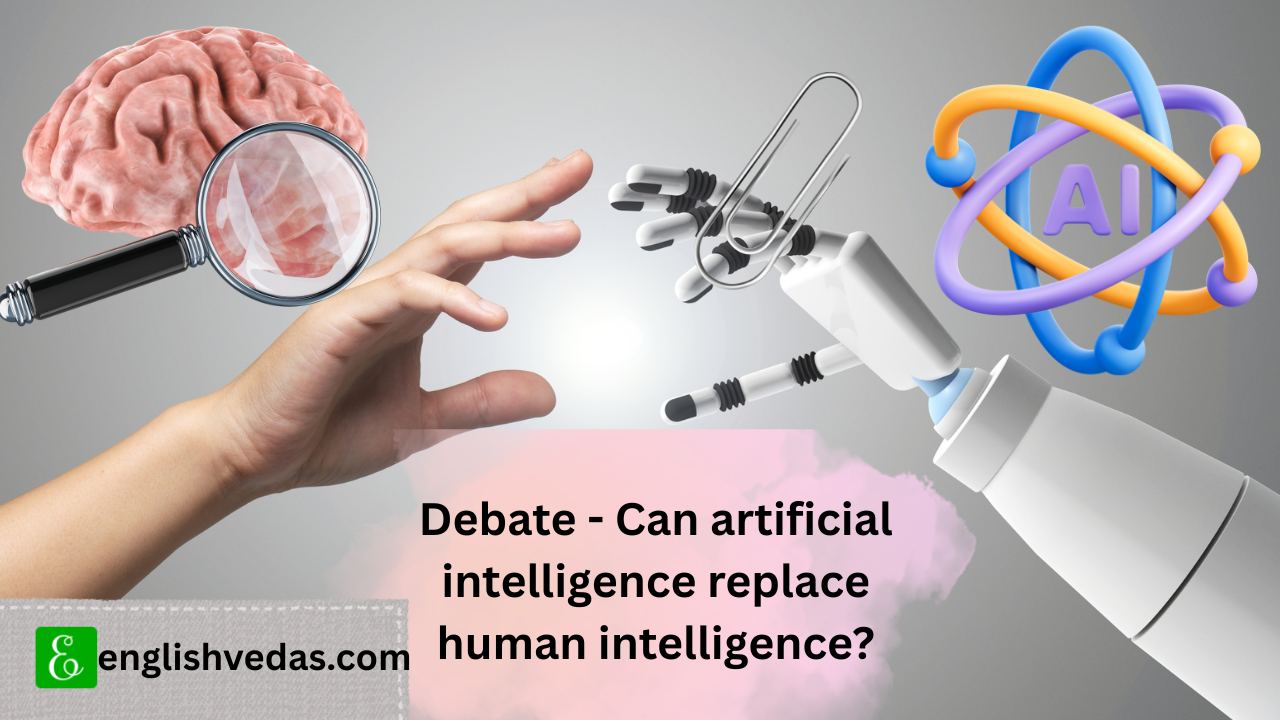
Can artificial intelligence replace human intelligence? This is a heated debate topic in 2026. The role of artificial intelligence has increased in 2026 with the rapid advancement of technology. AI can mimic human behaviour and thought processes. It automates mundane tasks that require no human input. This debate topic revolves around artificial intelligence and human intelligence. It will shed light on points for and against whether artificial intelligence can replace human intelligence.
Points for (AI Can Replace Human Intelligence)| Can Artificial Intelligence Replace Human Intelligence Debate
- Speed and Efficiency – AI is the most transformative technology.
It has been revolutionising industries and reshaping societal norms.
It can process massive data sets in seconds.
It is useful for industries like health care, finance, logistics and customer service.
Artificial intelligence is also good for writing, analysis, data heavy tasks.
It is said that generative AI improves performance by 38% to 39%. Task completion time drops by 40% and output quality improved by 88%.
In some cases, novices performed as good as experts.
PWC’s Global Workforce Hopes and Fears Survey 2025 – Australian insights. Workers in Australia say that they have used AI for their jobs in the past year. 72% say AI is increasing productivity and 70% of the workers say that it enhances the quality of their work.
2. Accuracy – AI involves large data sets and has complex pattern recognition.
It is consistent and precise.
It can quickly make decisions even with limited data.
Research (Can we trust AI? Exploring the effect of estimated accuracy and the actual performance of AI systems on human-ai Collaboration by Zhaohua Deng and Dan Song, 2025) indicated that human cognitive absorption is mainly influenced by the estimated accuracy of AI systems. In contrast, the inconsistency between estimated accuracy and actual performance of AI systems leads to higher cognitive absorption, meaning humans invest more cognitive resources.
3. 24/7 Availability – AI systems don’t get fatigued. It can work without human support.
It is not restricted to a particular time zone as it serves customers across different time zones.
4. Automation of tasks – Studies show AI saves 1 to 5% of the total work hours.
Anthropic research teams took a sample of a hundred thousand conversations with its AI assistant Claude, then estimated how much time it saved for each conversation. It was found that an average task took 90 minutes to perform without AI, while with AI, it took about 18 minutes. Hence, tasks could be completed 80% faster.
5. Learning capability – AI learns faster. Stanford explained how LLM’s work. The models like ChatGPT, Claude, Gemini didn’t learn by someone programming answers into them. They learnt the same way a child learns language by reading billions of webpages. By doing that many times, the models learn to understand context, logic, and reasoning. Engineers show thousands of real conversations to these models. Then, real humans sit and compare two answers side by side and find out which one is better and more helpful. The model watches those decisions and learns what a good answer looks like.
Points Against (AI Can’t Replace Human Intelligence)
- Lack of emotion – AI does not feel emotions or has conscious experiences.
The Kuleshov Effect states that one cannot judge someone from the picture alone, one needs context to know how someone is feeling. One cannot predict how an individual is feeling based on the movement of their facial muscles alone.
AI can say sorry when it makes a mistake, it can express satisfaction with the job done well, but it fails to cry.
AI is a language model that works through neural networks that power it.
Though information about different emotions can be fed into AI, AI cannot experience them.
- Limited Creativity – AI can use things that are already online.
IT cannot come up with a new thought that is not online or that is not fed into its database.
Hence, there is a limit to where AI can take us.
AI offers a more diverse range of choices and perspectives in the creative world. It is still difficult for machines to attain genuine human-like intelligence.
It can write books, compose symphonies, and generate short films at the speed of thought.
Human creativity is born in chaos that machines don’t understand. AI doesn’t live to understand why it’s creating.
- Moral and ethical judgement – Sherry Turkle an American sociologist said that when we outsource our moral decisions to the machine, we risk losing the very process. In order to make a genuine moral decision, one has to care about the outcome.
A person has values that affect him, and he acts on those values, and not just pre-programmed learning like AI.
That requires a deep emotional connection to what you think you are doing.
- Dependence on data – There is no AI without data.
Data is the single largest factor in how the AI performs.
Data is the backbone of every AI system. So, to ensure good performance and create systems that are robust and accurate, AI systems need a huge amount of data; the more the data, the more the training. But accessing such a large amount of data is a challenge.
- Human intuition – Intuition is accumulated awareness.
Wisdom traditions emphasise gut feeling, divine inspiration, and inner knowing.
The Bhagavat Gita talks about wisdom beyond logic.
Tai Chi says true knowledge comes from flowing with nature, not just analysis.
AI can predict, optimise, and even outthink us.
Human intuition sees patterns before data does.
It is about knowing something without having information to logically explain it.
Something inside us says that this doesn’t feel right.
It comes from patterns we have unconsciously observed, our experiences, our interactions, our mistakes, and every subtle detail you didn’t realise you were storing.
In the AI replacing humans debate, there can be only one winner. The question of whether AI will replace human workers assumes that AI and humans have the same qualities and abilities — but, in reality, they don’t. Humans are intuitive, emotional, or culturally sensitive, which makes them effective.
References
- LIMITATIONS OF ARTIFICIAL INTELLIGENCE. WHY ARTIFICIAL INTELLIGENCE CANNOT REPLACE THE HUMAN MIND
- CAN WE TRUST AI? EXPLORING THE EFFECT OF ESTIMATED ACCURACY AND THE ACTUAL PERFORMANCE OF AI SYSTEMS ON HUMAN-AI COLLABORATION
- Does AI Really Make Us More Productive? | Vantage with Palki Sharma |
- AI Should Augment Human Intelligence, Not Replace It by David De Cremer and Garry Kasparov
Also Read:-
- Should Students Be Allowed to Use AI Tools for Assignments? | Pros and Cons | Debate
- Debate on Can AI Replace Teachers?|5 Points For and Against
- Debate: Are Friends Better Than Family in Today’s Modern Life?| Points For and Against 2026
- Informative Debate |The Internet Curbs Creativity: 5 Points for and Against

My name is Sukhjit Kaur, and I am an English educator with 17+ years of experience helping students master grammar and writing. Through EnglishVedas.com, I simplify English grammar using examples from daily life and classrooms. I’ve been analyzing English media for 17 years to help students understand how grammar lives in the real world.