
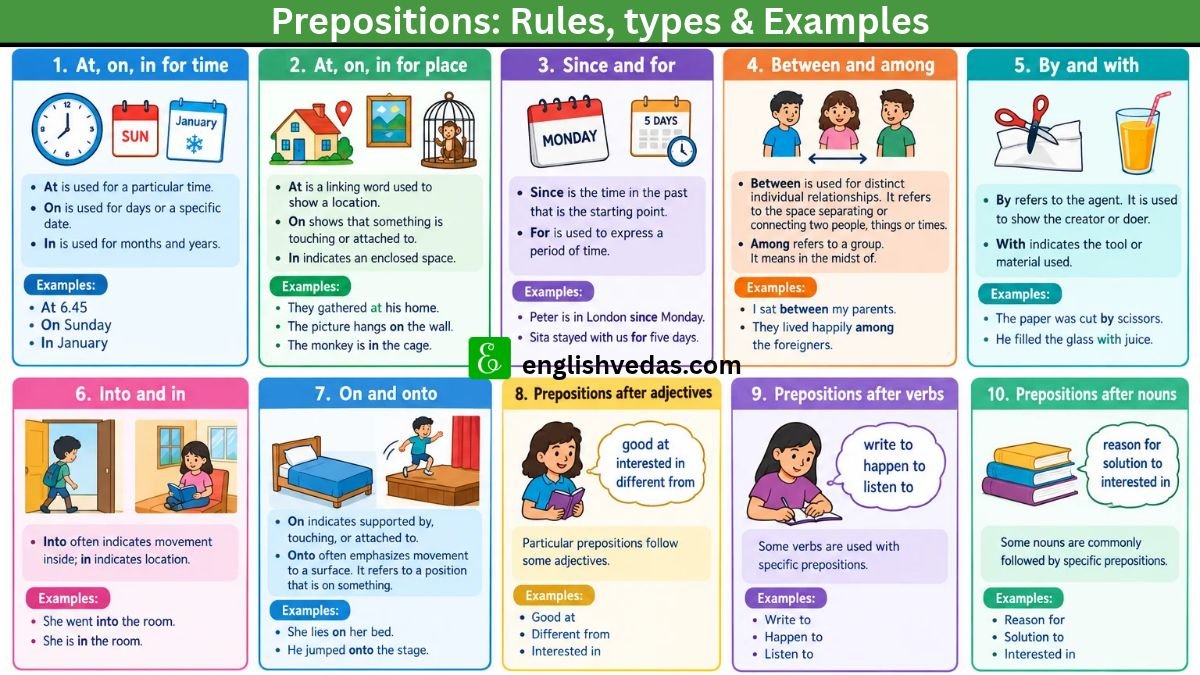
This article explains the prepositions rules types and examples to learners in a simple and easy manner.
Prepositions Rules Types and Examples
1. Introduction to Prepositions
A Preposition is a word that is used before a noun or a pronoun to show the relation between it and another word.
It can indicate place, time, direction, and movement.
Examples:
- The toy is on the bed.
- Jack will go to the market at 6.00 pm.
- The dog is sitting under the tree.
- He fell into the river.
2. Types of Prepositions with Examples
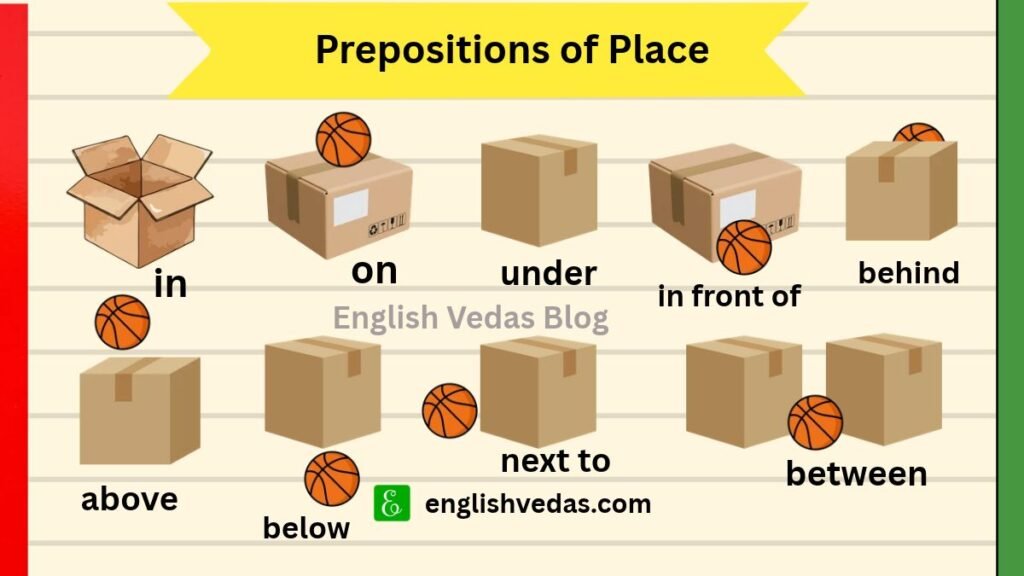
I usually explain prepositions rules types and examples to my students using a box and a ball as shown in the image above. Students understand easily with such practical examples and can confidently use prepositions to make sentences in English.
a) Prepositions of Place
This indicates where a person or a thing is located.
Examples: in, on, under, behind, beside, between, near.
- The box is in the cupboard.
- The books are on the shelf.
- There are some pictures on the wall.
b) Prepositions of Time
This shows the time when something happens.
Examples: at, on, in, before, after, during, since, for.
- He starts his class at 9 0’clcok.
- She died in 1978.
- They didn’t speak during the ceremony.
c) Prepositions of Direction and Movement
This indicates movement from one place to another.
Examples: to, into, onto, towards, through, across, along.
- She got into a car.
- A butterfly came into the room through a window.
- Frank walked towards the library.
d) Prepositions of Agent and Instrument
This shows who performs an action and what the person uses to perform.
- The book was written by Mohan.
- She cut the cloth with scissors.
- He watered the plants with a watering can.
e) Prepositions of Manner and Other Relationships
These can express manner, cause, purpose, or other relationships.
Examples: with, like, because of, for, about.
- Fill the bottle with hot water.
- He was prepared for the worst.
- He parted with all his property.
Common Prepositional Combinations (Prepositions Rules Types and Examples)
| Word | Correct combination | Example |
| Afraid | of | She is afraid of snakes. |
| Good | at | He is good at singing. |
| Belong | to | This book belongs to me. |
| Listen | to | He likes to listen to his friends. |
| Depend | on | It depends on what you are buying. |
| Believe | in | I believe in God. |
| Pity | for | He has no pity for poor labourers. |
| Prepared | for | John prepared for his exams. |
| Satisfied | with | Sue is satisfied with the results. |
Important Rules of Prepositions
| Rule | Explanation | Example |
| Rule 1: At, on, in for time | At is used for a particular time.On is used for days or a specific date.In is used for months and years. | At 6.45On SundayIn January |
| Rule 2: At, on, in for place | At is a linking word used to show a location. On shows that something is touching or attached to.In indicates an enclosed space. | They gathered at his home.The picture hangs on the wall. The monkey is in the cage. |
| Rule 3: Since and for | Since is the time in the past that is the starting point.For is used to express a period of time. | Peter is in London since Monday.Sita stayed with us for five days. |
| Rule 4: Between and among | Between is used for distinct individual relationships. It refers to the space separating or connecting two people, things, or times. Among refers to a group. It means in the midst of. | I sat between my parents. They lived happily among the foreigners. |
| Rule 5: By and with | By refers to the agent. It is used to show the creator or doer.With indicates the tool or material used. | The paper was cut by scissors.He filled the glass with juice. |
| Rule 6: Into and in | Into often indicates movement inside; in indicates location. | She went into the room.She is in the room. |
| Rule 7: On and onto | On indicates supported by, touching, or attached to. Onto often emphasizes movement to a surface. It refers to a position that is on something. | She lies on her bed.He jumped onto the stage. |
| Rule 8: Prepositions after adjectives | Particular prepositions follow some adjectives. | Good at, different from, interested in. |
| Rule 9: Prepositions after verbs | Some verbs are used with specific prepositions. | Write to, happen to, listen to. |
| Rule 10: Prepositions after nouns | Some nouns are commonly followed by specific prepositions. | Reason for, solution to, interested in. |
It is essential for the students to remember the prepositions rules types and examples so that they speak and write English fluently.
Also Read:-
- Prepositions Worksheet for Class 3 with Answers | Free Printable PDF
- Prepositions with Adjectives: 50 Easy Sentences and Examples
- Prepositions of Place Worksheet with Answers PDF (Free Download)
- At On In: Difference Worksheet and Exercises| Easy Rules

My name is Sukhjit Kaur, and I am an English educator with 17+ years of experience helping students master grammar and writing. Through EnglishVedas.com, I simplify English grammar using examples from daily life and classrooms. I’ve been analyzing English media for 17 years to help students understand how grammar lives in the real world.