
Adjectives Definition Types Rules and Examples
QUICK RULE: ADJECTIVES
1. Adjectives describe nouns or pronouns. Example: She has a beautiful dress.
2. Adjectives often come before nouns. Example: A clever student.
3. Adjectives can follow linking verbs. Example: The flowers are beautiful.
4. Adjectives usually do not change for singular and plural nouns. Example: a small box; two small boxes.
5. Use the correct degree of comparison. Example: tall → taller → tallest.
6. Do not confuse adjectives with adverbs. Example: a careful driver; drives carefully.
Remember: Ask What kind? How many? How much? or Which one? to help identify adjectives in a sentence.
Adjectives are an important part of English grammar lessons. An adjective is a word used to add something to the meaning of a noun or pronoun. For example, if instead of saying “Ravi is a boy,” I say “Ravi is a brilliant boy”. The word brilliant describes what kind of a boy Ravi is, and it makes the sentence meaningful.
In this guide, you will learn the definition of adjectives, their different types, important grammar rules, examples, and common mistakes. You will also learn how to identify adjectives in sentences and use them correctly in everyday English. The guide clearly explains adjectives’ definition, types, rules, and examples.
What is an adjective? Definition and Examples.
An adjective is a word that is used to describe a noun or a pronoun that is used to add some meaning to it. It may tell us about the quality, quantity, number, size, colour, shape, or other characteristics of a person, place, animal, or thing.
Examples:
- Rita is an honest girl.
- She drank some juice.
- He bought three books.
- It is a cloudy day.
- Bangalore is a big city.
In these sentences, honest, some, three, cloudy, and big are adjectives because they describe a noun.
How to Identify an Adjective
To identify an adjective, look for a word that describes a noun or pronoun or tells us more about it.
Ask questions such as:
- What kind? — a beautiful dress
- How many? — five pens
- How much? — little food
- Which one? — this book
- Whose? — my phone
Remember that not every describing word is an adjective in every sentence. Its function in the sentence matters.
Types of Adjectives with Examples
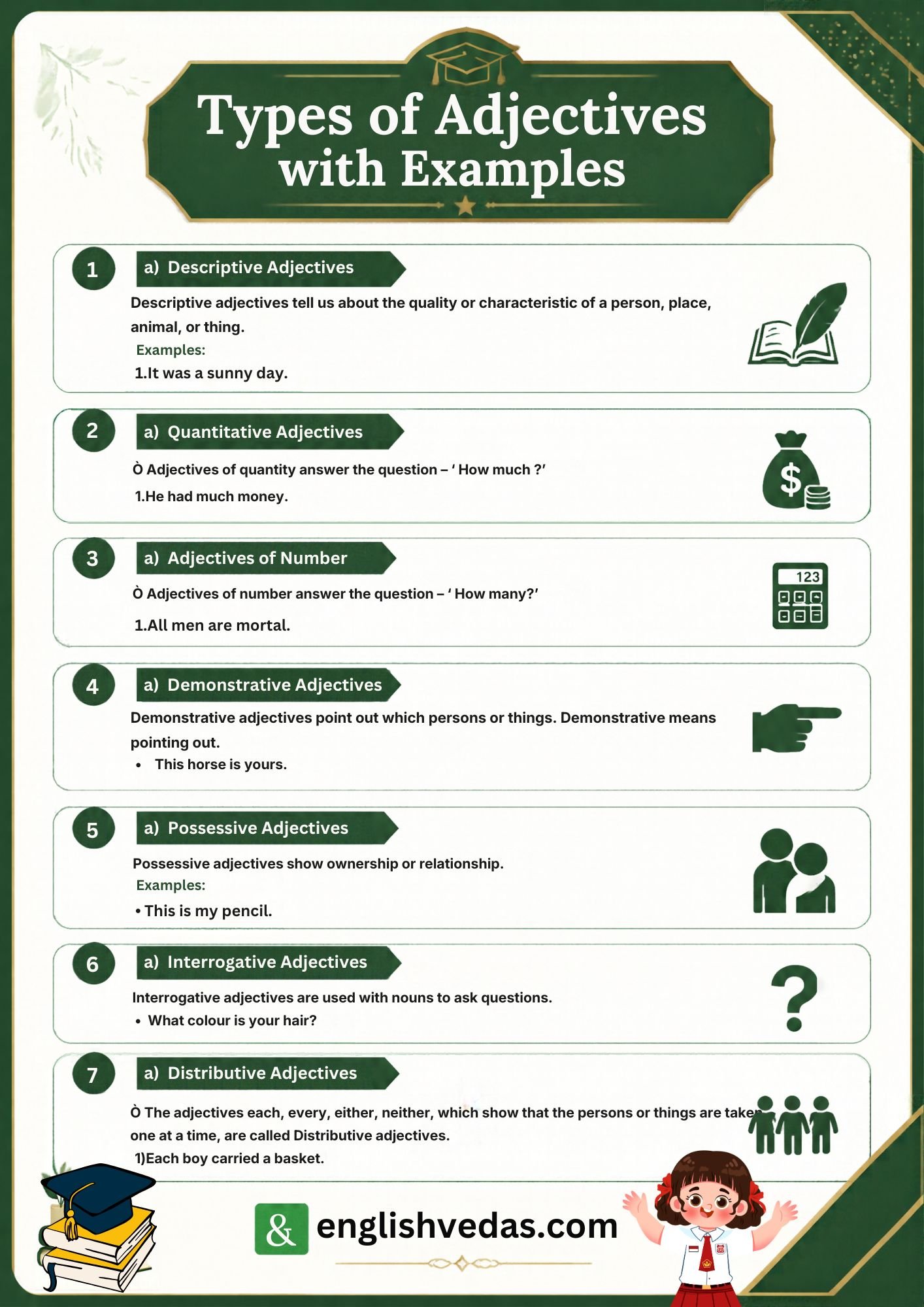
- Descriptive Adjectives
Descriptive adjectives tell us about the quality or characteristic of a person, place, animal, or thing.
Examples:
- It was a sunny day.
- Joshi is a clever man.
- The rose is a beautiful flower.
Other examples include sunny, clever, and beautiful.
- Quantitative Adjectives
- Adjectives of quantity answer the question – ‘ How much ?’
- He had much money.
- He did not eat any bread.
- He had sufficient milk.
- He wants some money.
- There is a little food in the house.
In the above sentences, much, any, sufficient, some, and little are quantitative adjectives.
- Adjectives of Number
- Adjectives of number answer the question – ‘ How many?’
- All men are mortal.
- Many women were not there.
- He had five rupees in his pocket.
- The first boy won the prize.
In the sentences above, the adjectives of number are all, many, five, and first.
- Demonstrative Adjectives
Demonstrative adjectives point out which persons or things. Demonstrative means pointing out.
- This horse is yours.
- I want those apples.
- I like these mangoes.
This, these, and those are demonstrative adjectives.
Note: This and that are used with singular nouns; these and those with plural nouns.
- Possessive Adjectives
Possessive adjectives show ownership or relationship.
Examples:
- This is my pencil.
- Her siter is a teacher.
- Their house is near the park.
Common possessive adjectives include my, your, his, her, its, our, and their.
- Interrogative Adjectives
Interrogative adjectives are used with nouns to ask questions.
- What colour is your hair?
- Which house is yours?
- Whose book is this?
In the sentences above, what, which, and whose are interrogative adjectives.
- Distributive Adjectives
- The adjectives each, every, either, neither, which show that the persons or things are taken one at a time, are called Distributive adjectives.
- Each boy carried a basket.
- Every word of it is true.
- Either pencil will do.
- Neither girl is likely to fail.
The adjectives each, every, either, and neither are distributive adjectives.
Important Rules of Adjectives (Adjectives Definition Types Rules and Examples)
I explain adjective rules to my students so that they can write and speak correct sentences in English.
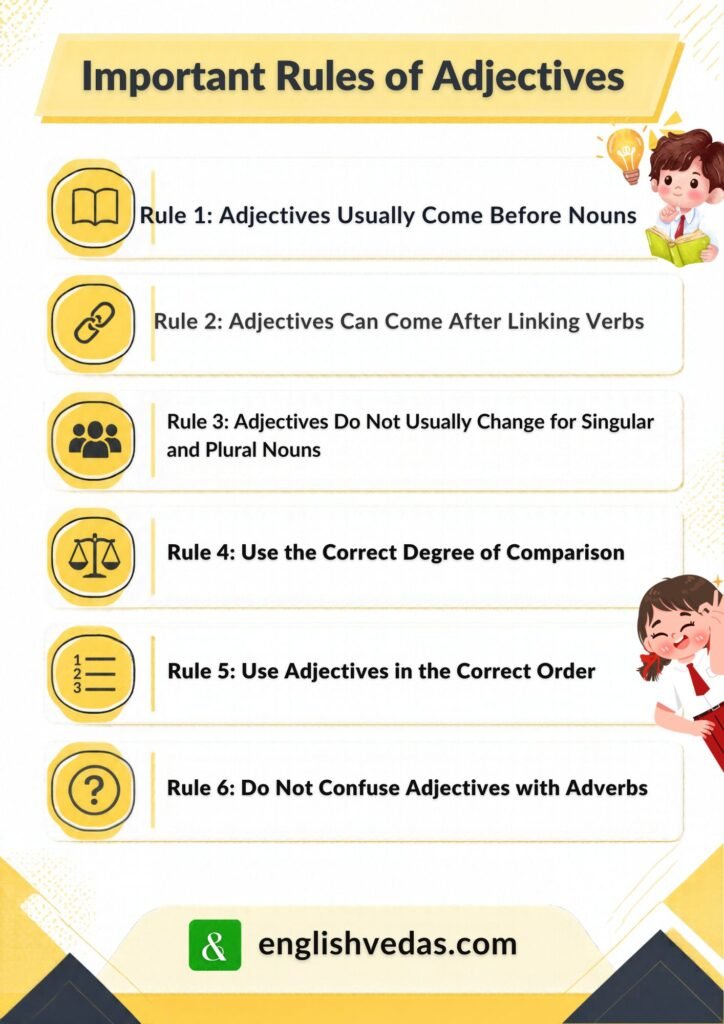
Rule 1: Adjectives Usually Come Before Nouns
In sentences in English, adjectives are used before the nouns that describe it.
Examples:
Adjective + noun
He has got an old bag.
It is a nice day today.
There is an old church in this city.
Rule 2: Adjectives Can Come After Linking Verbs
Adjectives can also follow linking verbs such as is, am, are, was, were, seem, look, and feel.
Examples:
I am thirsty. Can I have a glass of water?
Sita looks tired.
These flowers smell nice.
The class was interesting.
Rule 3: Adjectives Do Not Usually Change for Singular and Plural Nouns
Adjectives do not change their form when the nouns change from singular to plural.
Examples:
- A small cup
- Two small cups
- A modern house
- Three modern houses
- A hungry dog
- Two hungry dogs
Rule 4: Use the Correct Degree of Comparison
Adjectives have three degrees of comparison.
- Positive: fat
- Comparative: fatter
- Superlative: fattest
Examples:
- Rajeev is busy.
- Rajeev is busier than Pankaj.
- Rajeev is the busiest boy in the building.
Rule 5: Use Adjectives in the Correct Order
We can use adjectives with a noun by following a conventional order.
A common pattern is:
Opinion → Size → Age → Shape → Colour → Origin → Material → Purpose → Noun
Example: George bought a beautiful big new round white Italian wooden chair.
Rule 6: Do Not Confuse Adjectives with Adverbs
Adverbs describe verbs, adjectives, and other adverbs.
Adjective +ly = Adverb
| Adjective | Adverb |
| Quick | Quickly |
| Quiet | Quietly |
| Silent | Silently |
| Careful | Carefully |
| Bad | Badly |
Learners can easily understand the adjectives’ definition, types, rules, and examples with the help of this guide. To learn and practice adjectives’ definition, types, rules, and examples, they can visit the worksheets below.
Also Read:-
- Adjectives Worksheet for Class 3 with Answers | Free Printable
- Adjectives Worksheet for Class 2 – Free Printable PDF with Answers
- Adjective Worksheet for Class 1
- Comparison of Adjectives Worksheet with Answers

My name is Sukhjit Kaur, and I am an English educator with 17+ years of experience helping students master grammar and writing. Through EnglishVedas.com, I simplify English grammar using examples from daily life and classrooms. I’ve been analyzing English media for 17 years to help students understand how grammar lives in the real world.