
Verbs are an important part of English grammar because they express actions, states, and happenings. Understanding the verbs definition, types, rules and examples helps students identify verbs in sentences and use them correctly. In this guide, you will learn the definition of verbs, different types of verbs, essential grammar rules, and examples that make learning easy.
A verb expresses action, feeling, existence, state, or change.
It explains what the subject does, what happened to the subject, what will happen to the subject, what the subject is, etc.
Examples:
- He does his homework in the evening.
- Samuel goes to the market every Sunday.
- The ball bounced.
- A cheetah runs very fast.
- I have a cup of tea in the morning.
Verbs Definition
A verb is a word that expresses an action, a state or a happening.
Examples:
- Action: Priya sings well.
- State: I know the answer.
- Happening: The leaves fell from the tree.
Types of Verbs in English (Verbs Definition Types Rules and Examples)
| Type | Example |
| Action Verb | She writes neatly. |
| Linking Verb | They are excited. |
| Helping Verb | He is reading. |
| Transitive Verb | The carpenter made a table. |
| Intransitive Verb | The birds flew away. |
| Modal Verb | You should study. |
These categories can overlap. For example, is can function as a linking verb or as a helping verb, depending on the sentence.
Verb Forms: V1, V2, V3, V4 and V5 (Verbs Definition Types Rules and Examples)
| Form | Example |
| V1 — base form | Eat |
| V2 — past form | Ate |
| V3 — past participle | Eaten |
| V4 — -ing form | Eating |
| V5 — -s/-es form | Eats |
Some more examples of different forms of verb.
| Present | Past | Past Participle | ing Form | s/-es form |
| Be(am/is/are) | Was/were | been | Being | Is |
| Begin | Began | Begun | Beginning | Begins |
| Benefit | Benefited | Benefited | Benefiting | Benefits |
| Carry | Carried | Carried | Carrying | Carries |
| Catch | Caught | Caught | Catching | Catches |
| Choose | Chose | Chosen | Choosing | Chooses |
| Do | Did | Done | Doing | Does |
| Drink | Drank | Drunk | Drinking | Drinks |
| Fly | Flew | Flown | Flying | Flies |
| Forget | Forgot | Forgotten | Forgetting | Forget |
| Go | Went | Gone | Going | Goes |
| Get | Got | Got | Getting | Gets |
| Grow | Grew | Grown | Growing | Grows |
| Have | Had | Had | Having | Has |
| Make | Made | Made | Making | Makes |
| Meet | Met | Met | Meeting | Meets |
| Pay | Paid | Paid | Paying | Pays |
| Pray | Prayed | Prayed | Praying | Prays |
| Read | Read | Read | Reading | Reads |
| Say | Said | Said | Saying | Says |
| Ride | Rode | Ridden | Riding | Rides |
| Run | Ran | Run | Running | Runs |
| See | Saw | Seen | Seeing | Sees |
| Take | took | Taken | Taking | Takes |
Remember:-
- Most verbs take -s: drink → drinks.
- Verbs ending in -ch, -sh, -s, -x, or -o often take -es: catch → catches; go → goes.
- Verbs ending in a consonant + y change y to ies: carry → carries.
- Have changes to has, and be changes to is for he, she or it.
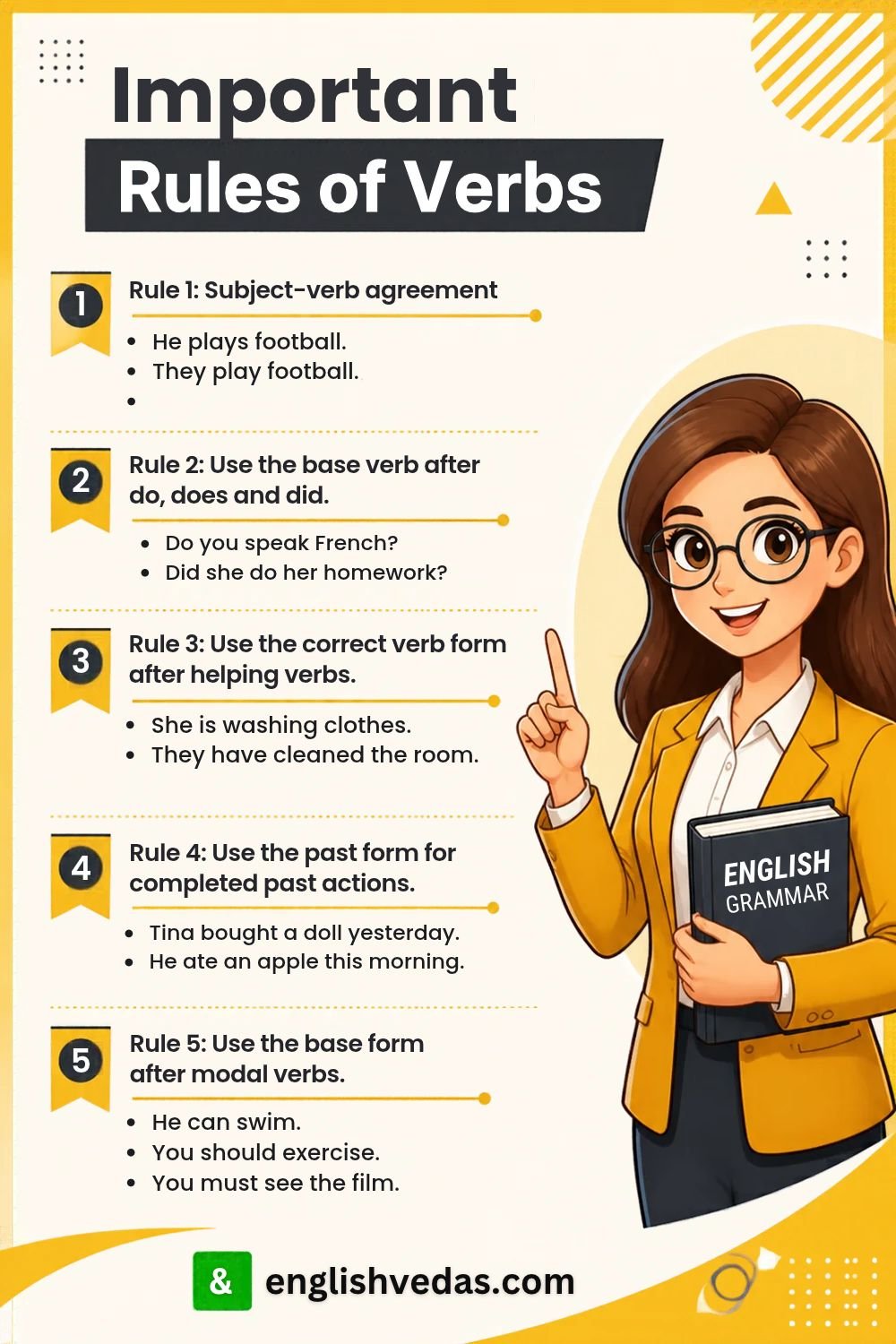
Important Rules of Verbs
The examples given demonstrate the grammar rules of verbs.
Rule 1: Subject–verb agreement
- He plays football.
- They play football.
Rule 2: Use the base verb after do, does and did.
- Do you speak French?
- Does he have a dog?
- Did she do her homework?
Rule 3: Use the correct verb form after helping verbs.
- She is washing clothes.
- They have cleaned the room.
Rule 4: Use the past form for completed past actions.
- Tina bought a doll yesterday.
- Robert worked in a bank 5 years ago.
- He ate an apple this morning.
Rule 5: Use the base form after modal verbs.
- He can swim.
- You should exercise.
- You must see the film.
Verbs Used in Sentences
- Positive: He dances well.
- Negative: He does not dance well.
- Question: Does he dance well?
- Past: He danced well.
- Future: He will dance well.
An Activity-Based Approach to Teaching Verbs
In my experience as an English teacher and mentor, I have found that students understand grammar concepts more easily when they learn through activities. One activity I often used in my classroom involved writing subjects such as I, we, you, they, he, she, and it on separate pieces of paper and giving one to each student.
Similarly, I wrote helping verbs, linking verbs, and action verbs on separate pieces of paper and distributed them among the students. The students then had to work together to form five grammatically correct sentences and demonstrate them in front of the class within a given time limit.
The team that formed the sentences correctly and completed the activity in the shortest time was declared the winner.
This activity made grammar lessons interactive, enjoyable, and competitive. It encouraged students to participate actively, think quickly, and understand sentence structure through hands-on learning rather than simply memorising grammar rules.
Common Mistakes in Using Verbs
| Incorrect | Correct |
| She like to draw. | She likes to draw. |
| He did not came | He did not come. |
| We is worried. | We are worried. |
| He can swims. | He can swim. |
| I am forgive. | I forgive. |
| Sue go to the market yesterday | Sue went to the market yesterday. |
| Do you met your friend ? | Do you meet your friend? |
| Does he had a car? | Does he have a car? |
| They have wash the clothes. | They have washed the clothes. |
| He are listening to music. | He is listening to music. |
A common mistake students make is using the wrong verb form with the subject. They forget that with do, does, and did they have to use the base form of the verb (V1).
By going through this guide students will learn Verbs Definition Types Rules and Examples which will make them more confident about making sentences correctly.
Tenses are a natural next step after understanding verbs.
Learn about tenses, their rules and examples
Also Read:-
- Helping Verbs Worksheet for Class 2 Best
- How to Use Causative Verbs in English Grammar (Have, Make, Get, Let) with Easy Examples
- Simple Present Tense Worksheet
- Subject Verb Agreement Exercise for Class 10 with Answers

My name is Sukhjit Kaur, and I am an English educator with 17+ years of experience helping students master grammar and writing. Through EnglishVedas.com, I simplify English grammar using examples from daily life and classrooms. I’ve been analyzing English media for 17 years to help students understand how grammar lives in the real world.