
Social media connects us, informs us, and entertains us.
But should it be allowed for children under 16? We are diving into this controversial question. Should social media be banned for kids under 16?
Social media is everywhere, from Instagram to TikTok to Facebook to Snapchat. Kids spend a huge amount of time on this digital playground. As the usage of this platform has grown, it has become a growing concern. Let me walk you through the arguments for and against the debate on whether the minimum age for social media use should be 16.
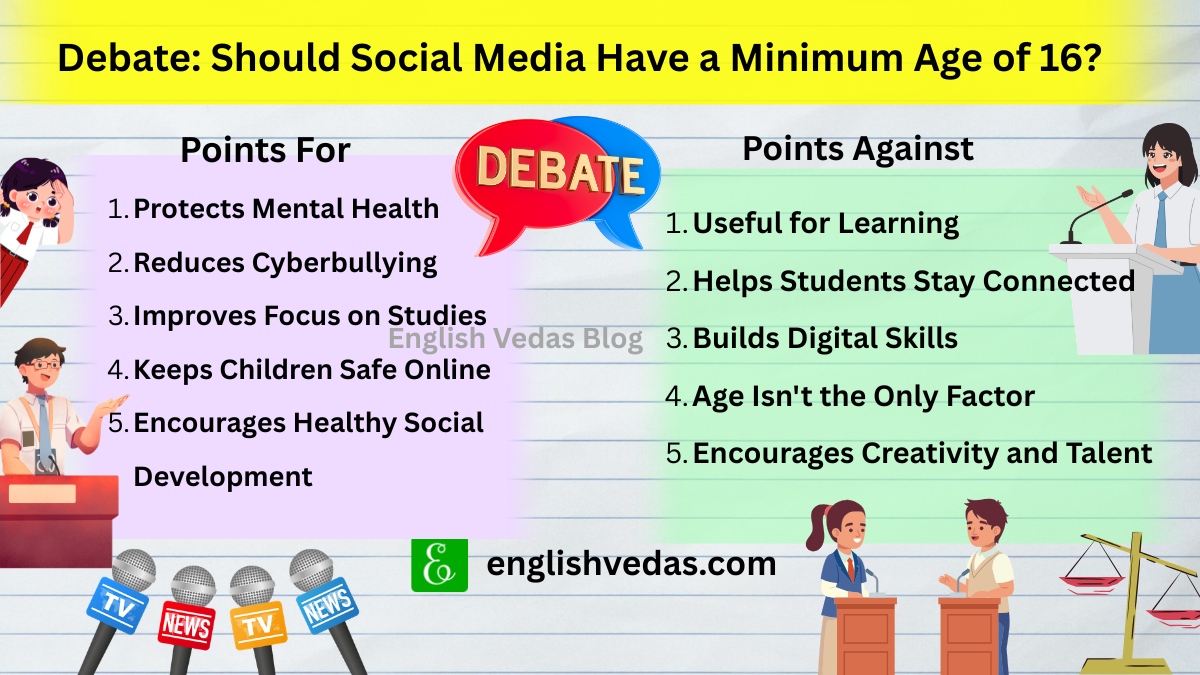
Points For (Yes, the minimum age should be 16)| Should Social Media Have a Minimum Age of 16?
- Protects Mental Health
Teenagers under 16 are more likely to experience anxiety, depression, and low self-esteem due to excessive social media use.
According to a study by the American Psychological Association, teenagers who spend more than three hours a day on social media are more likely to report mental health issues. Restricting social media for kids can protect them from these harmful effects.
They can develop feelings of inadequacy which leads to high stress level.
It keeps young people safe and also secures their future.
They will not be exposed to harmful content on social media.
- Reduces Cyberbullying
Younger children are more vulnerable to online bullying, which can negatively affect their confidence, academic performance, and emotional well-being.
Children need protection from online predators and inappropriate content. When kids use social media platforms 24 x 7, it becomes difficult for parents to monitor them. The kids are vulnerable to harm that social media brings.
The main reason behind the ban is to protect children from online abuse.
When children spend less time on social media, the automatically will spend time in sports and arts.
- Improves Focus on Studies
Limiting social media access helps students spend more time on schoolwork, reading, sports, and other productive activities.
Social media gives micro-dopamine rewards to teens who use it. Excessive use of social media makes them addicted to task switching, which prevents them from entering into a deep state of flow.
When they focus their undivided attention on studies, they retain information learned for a longer time.
- Keeps Children Safe Online
A higher age limit reduces exposure to online predators, scams, inappropriate content, and privacy risks.
Many parents want to protect their children from the dangers of using social media, and they fail to understand how to strike a balance. They cannot decide whether they should impose strict rules or teach their children to navigate it responsibly.
- Encourages Healthy Social Development
Face-to-face interactions help children develop communication skills, empathy, and stronger real-life relationships before relying on digital platforms.
Face-to-face interaction plays a pivotal role in the cognitive development of children and helps them to develop healthy relationships with others.
They can join local clubs and participate in community events. Such positive social support helps them to grow as confident individuals.
Points Against (No, the minimum age should not be 16)
- Useful for Learning
Social media offers educational videos, language-learning pages, science channels, and study groups that benefit students.
Children use social media for creative expression. They build communities around their shared interests.
Children get access to educational content and find new opportunities.
They get a chance to raise awareness about important social issues.
- Helps Students Stay Connected
Children can easily communicate with friends, classmates, teachers, and family members. It strengthens the bond between them. Social media helps when students make school projects or are stuck in emergencies.
Social media helps in academic collaboration. It enables instant communication between mentors and classmates. Children can connect with professionals across the globe. Certain virtual communities provide safe places for kids to seek emotional support and share experiences. Suppose a poor student needs homework help; he can easily get help from social media groups.
- Builds Digital Skills
Using social media correctly helps teenagers develop digital literacy, communication skills, and online safety awareness. They become tech-savvy.
Children learn to navigate apps and create content. They learn graphic design and multimedia. They also learn the art of evaluating information by locating trusted sources. They understand netiquette when they interact with people across the globe. Young people can also use platforms like LinkedIn for digital relationship building.
- Age Isn’t the Only Factor
Some children under 16 are mature enough to use social media responsibly, while some older users may misuse it. Parental guidance is often more effective than strict age limits.
It is beneficial for young people who are physically restricted or geographically isolated.
Teenagers are at an age where they are developing their identities. Social media gives them a place to share, connect, and exchange their thoughts with others.
These days, children showcase their talent on social media platforms and earn financial benefits, and it boosts their self-esteem. So age cannot be the only criterion for banning social media for kids under 16.
The ban infringes on the rights of teenagers.
- Encourages Creativity and Talent
Many young creators use social media to share art, music, writing, coding projects, and educational content, helping them gain confidence and opportunities.
For example, Ryan Kaji started a YouTube channel at the age of 4, and he has built an empire of toy reviews, science experiments, and family challenges. Another good example is Greta Thunberg, who has used social media for activism and created a worldwide climate awareness movement through a platform like Twitter.
Conclusion
Whether social media should have a minimum age of 16 remains a debated issue. Supporters believe it protects children’s mental health, keeps them safe, and increases their focus in studies. At the same time, opponents argue that responsible use, parental supervision, and digital education are better solutions than a complete age restriction. Some experts suggest that a complete ban is not a solution, but education and moderation is.
Children should be taught how to use social media responsibly, how to spot misinformation, and how to protect their privacy and set boundaries.
Parents can help children thrive online by keeping them safe.
Around the world, many countries are regulating social media for young users.
In some countries, there are strict laws about who can access social media and when.
The solution is not a complete ban but finding a middle ground.
Hence, the best approach may be to balance online opportunities with strong safety measures and guidance.
Also Read:-
- Can Money Buy Happiness? Debate with Arguments For and Against
- Can Artificial Intelligence Replace Human Intelligence?| Best Debate 2026
- Will Artificial Intelligence Create More Jobs or Take Away Jobs in the Future?|Debate
- The Great School Uniform Showdown: Why the ‘Should School Uniform Be Mandatory’ Debate 2026
- Artificial Intelligence: A Boon or a Bane for Students? |Debate 2026
- Debate on Can AI Replace Teachers?|5 Points For and Against
- Debate: Are Friends Better Than Family in Today’s Modern Life?| Points For and Against 2026
- Should Students Be Allowed to Use AI Tools for Assignments? | Pros and Cons | Debate

My name is Sukhjit Kaur, and I am an English educator with 17+ years of experience helping students master grammar and writing. Through EnglishVedas.com, I simplify English grammar using examples from daily life and classrooms. I’ve been analyzing English media for 17 years to help students understand how grammar lives in the real world.