
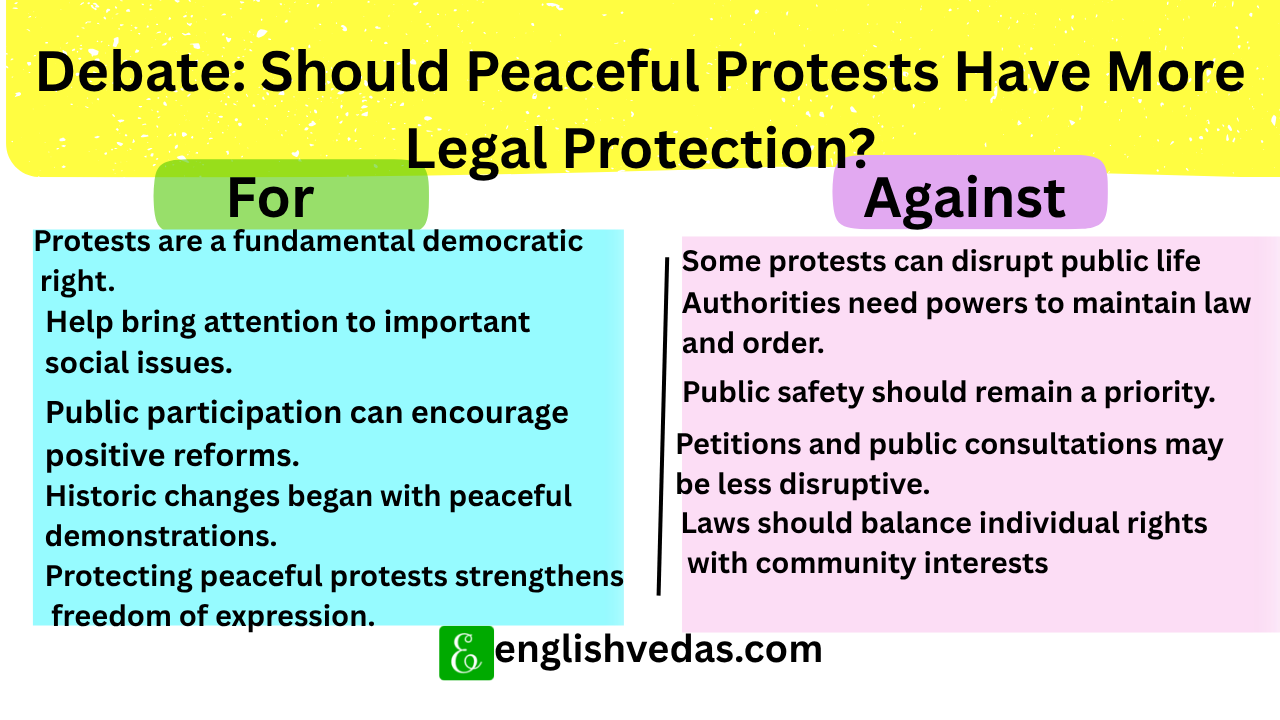
Whether peaceful protests should have more legal protection is a controversial topic of debate. Peaceful protests are a fundamental democratic right of a citizen, bring attention to social issues, provide a voice to minority groups, and result in positive reforms. On the other hand, protests can disrupt public life, authorities need power to maintain law and order; public safety is a priority, and laws should balance individual rights with community interests. Let us discuss the points for and against the given topic.
Points for the Debate: Should Peaceful Protests Have More Legal Protection?
- Peaceful protests are a fundamental democratic right.
In a democracy, protesting is a citizen’s basic right. A democratic government is considered better because it is accountable. For instance, the Cockroach Janta Party protest is a peaceful protest by the students of India regarding NEET paper leak.
- They help bring attention to important social issues. For instance, the Anna Hazare’s prominent 2011 anti-corruption protests were called the India Against Corruption (IAC) movement and the Jan Lokpal Andolan. Secondly, the Cockroach Janta Party (CJP) led mass protests in New Delhi demanding the resignation of Education Minister Dharmendra Pradhan over widespread exam paper leaks and recruitment scandals.
- Public participation can encourage positive reforms. People realize that they are not alone. Protests empower people and show that thousands of people think the same. Let us look at the two major protests and the reforms that were outcome of it. For example, The Indian Farmers’ Protest (2020–2021) in November 2021, the Indian government formally repealed the three controversial farm laws. Secondly, The 2011 India Against Corruption Movement which led directly to Parliament passing the Lokpal and Lokayuktas Act, 2013, creating a national ombudsman to investigate corruption.
- Many historic changes began with peaceful demonstrations.
- Chipko Movement (1973) by rural peasant women where they hugged trees to protect the Himalayan forests.
- 2017 Pro-Jallikattu Protests in Tamil Nadu where people demanded revocation of the Supreme Court ban on the traditional bull-taming sport.
- Shaheen Bagh Protests (201 9–2020) were a protest by the local women in Delhi to protest the Citizenship Amendment Act (CAA).n
- Protecting peaceful protests strengthens freedom of expression.
- Protests provide a voice to minority groups. For instance, in the CJP protest, one can see a sea of young, angry people speaking. They can speak truth to those in power. Language has given the young of India the power to file RTI after RTI, to gather information on India’s supreme power.
Points Against the Debate: Should Peaceful Protests Have More Legal Protection?
- Some protests can disrupt public life and essential services.
Protests become testing grounds for the health of our democracy. Commuters have experienced major traffic jams in Delhi due to the CJP protest. Mobile internet services and data connectivity were suspended within a radius of 1.5 km. Even some shops, offices, and restaurants near Connaught Place shut down.
- Authorities need powers to maintain law and order. To prevent violence and make sure that the rights of citizens are protected, maintenance of law and order is mandatory. It becomes important to identify the law breakers and take against individuals who break law.
- Public safety should remain a priority. Sometimes public safety is under threat when protesters resort to vandalism. A designated zone for demonstration can separate peaceful demonstrators from agitators. Authorities should not use force to suppress crowd flow. For example, during the Cockroach Janta Party protests, there were clashes between the youth and the Delhi police, so multi-layered barricades were put. Almost 16 metro stations were closed to stop entry to Jantar Mantar, where protests are being held.
- Alternative methods like petitions and public consultations may be less disruptive. In India, gathering signatures through petitions, participating in government forums, filing lawsuits against unjust laws, and running awareness campaigns are less disruptive ways.
In a democracy like India it reduces community backlash and also leads to strong documentation.
The major citizen-led petitions in India were Mandatory Caesarean Section (C-Section) Disclosure, Action Against the Leslee Udwin “India’s Daughter” Documentary Lawyers, and The “No Vaccine, No School” Campaign.
- Laws should balance individual rights with community interests.
The Indian Constitution embodies a deliberate tension between individual liberty and collective discipline, seeking to safeguard fundamental freedoms while ensuring the stability of democratic order.
Rights under Part III, particularly Articles 19 and 21, guarantee a wide spectrum of liberties but subject them to “reasonable restrictions” aimed at protecting sovereignty, security, public order, morality, and related interests.
In recent years, the Indian judiciary has been at the forefront of protecting the rights of marginalized communities, such as women, Dalits, and Adivasis. The judiciary has taken a proactive stance in protecting the rights of these communities, interpreting our Constitution and laws in a manner that promotes their well-being and dignity.
References
- : https://www.ijllr.com/post/how-effective-are-constitutional-restrictions-in-balancing-personal-liberty-and-public-discipline-in
- : https://www.juscorpus.com/the-indian-judiciary-approach-to-balancing-the-rights-of-individuals-and-the-public-interest/
Also Read:-
- Should Social Media Have a Minimum Age of 16? |Debate
- Can Money Buy Happiness? Debate with Arguments For and Against
- Can Artificial Intelligence Replace Human Intelligence?| Best Debate 2026
- Should Students Be Allowed to Use AI Tools for Assignments? | Pros and Cons | Debate
- Will Artificial Intelligence Create More Jobs or Take Away Jobs in the Future?|Debate
- Artificial Intelligence: A Boon or a Bane for Students? |Debate 2026
- Debate on Can AI Replace Teachers?|5 Points For and Against

My name is Sukhjit Kaur, and I am an English educator with 17+ years of experience helping students master grammar and writing. Through EnglishVedas.com, I simplify English grammar using examples from daily life and classrooms. I’ve been analyzing English media for 17 years to help students understand how grammar lives in the real world.