
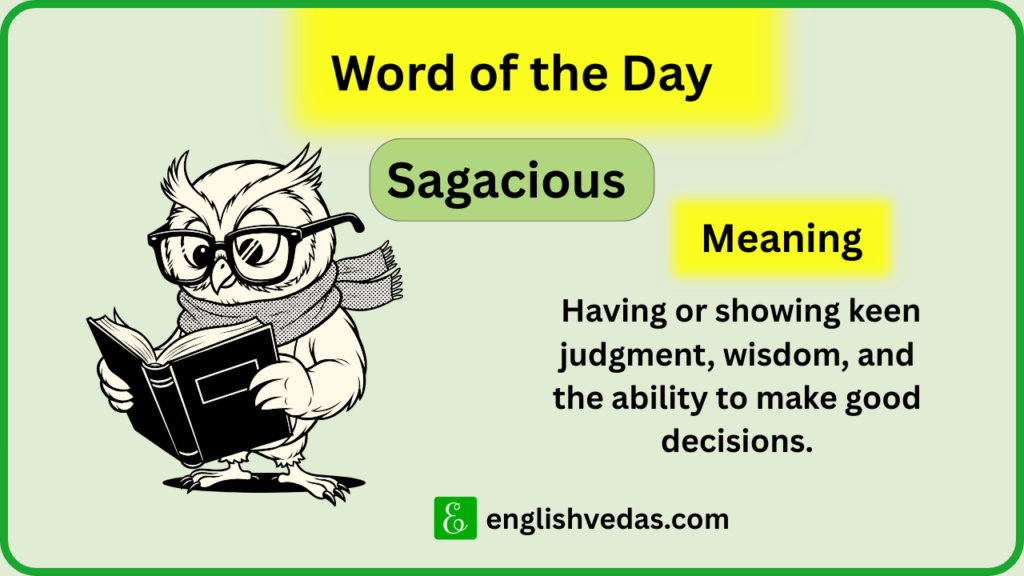
Sagacious Meaning and Pronunciation
Word of the Day – Sagacious
Meaning – a formal word for shrewd, with practical wisdom and good judgment.
It is an adjective which is used to describe an intelligent person and someone who shows keen mental discernment.
Pronunciation – suh·gay·shuhs
When would I actually use this word in real life?
A sagacious person is someone who uses their wisdom, knowledge, judgment skills, and experience to make sensible decisions. They usually weigh the pros and cons of an action before choosing a course of action. This word cannot be used for an object. Mentors, leaders, parents, and grandparents are described as sagacious because they give good advice.
Example Sentences
The judge’s sagacious decision solved a difficult problem.
2. He planned the ad campaign with great sagacity.
3. The sagacious teacher guided her students through every challenge with patience and wisdom.
4. His sagacious advice helped the team avoid a costly mistake.
5. Her sagacious grandmother helped her to arrange the house.
6. The sagacious union leader fought for the demands of the workers.
7. The cat is a sagacious animal, often showing great intelligence.
8. The doctor’s sagacious advice helped the patient.
Sagacious Synonyms and Antonyms
The word sagacious has several synonyms, including wise, prudent, judicious, astute, perceptive, insightful, discerning, thoughtful, sensible, and intelligent. Although these words are similar, sagacious especially emphasizes wisdom gained through experience and sound judgment. Common antonyms include foolish, unwise, imprudent, careless, ignorant, reckless, and short-sighted, which describe people who make poor or thoughtless decisions.
Common Collocations
The Common collocations for sagacious are sagacious leader, sagacious advice, sagacious businessman, sagacious observer, and remain sagacious. The commonly used verbs with sagacious are remain, prove, and consider. One can also use it by saying someone is politically sagacious. Hence, adverb modifiers like highly, remarkably, and politically can be used.
Word Family
The word sagacious can be used differently in different situations.
- Sagacious (Adjective): Having wisdom, good judgment, and keen understanding.
- Sagaciously (Adverb): Wisely and thoughtfully.
- Sagaciousness (Noun): The quality of being wise and having good judgment.
- Sagacity (Noun): Wisdom, intelligence, and the ability to make sound decisions.
Examples:
- The sagacious teacher helped the students in difficult times.
- The nurse sagaciously helped the patient.
- The employee’s sagacity impressed his boss.
- The old man was known for his sagaciousness.
Mini Quiz
Test Your Understanding of “Sagacious”
Choose the correct answer.
Which sentence uses the word sagacious correctly?
A. The sagacious knife was very sharp.
B. The sagacious box was spacious.
C. The sagacious rain soaked the streets.
D. The sagacious rescuer saved the boy. ✅
2. Fill in the blank.
The old man was known for his __________ advice during difficult times.
Answer: sagacious
3. True or False
A sagacious person never decides without thinking.
Answer: False
4. Find the synonym.
Which word is closest in meaning to sagacious?
A. Anxious
B. Wise
C. Angry
D. hardworking
5. Write Your Own Sentence
Use the word sagacious in a sentence of your own.
Tips to remember the word
A simple way to remember the word sagacious is to visualize an owl, which is considered wise and intelligent. An owl’s large brain is specialized for sharp vision and acute hearing to hunt. An owl observes before making a move. Similarly, a sagacious person will think before acting so that he can make smart decisions.
Also Read:-
- Idioms for Class 5 | Simple and Easy
- Animal Idioms Worksheet with Answers | Simple
- List of 50 Vocabulary Words for Class 4 | Best Words with Meanings
- List of 50 Vocabulary Words for Class 3 | Best Words with Meanings

My name is Sukhjit Kaur, and I am an English educator with 17+ years of experience helping students master grammar and writing. Through EnglishVedas.com, I simplify English grammar using examples from daily life and classrooms. I’ve been analyzing English media for 17 years to help students understand how grammar lives in the real world.