
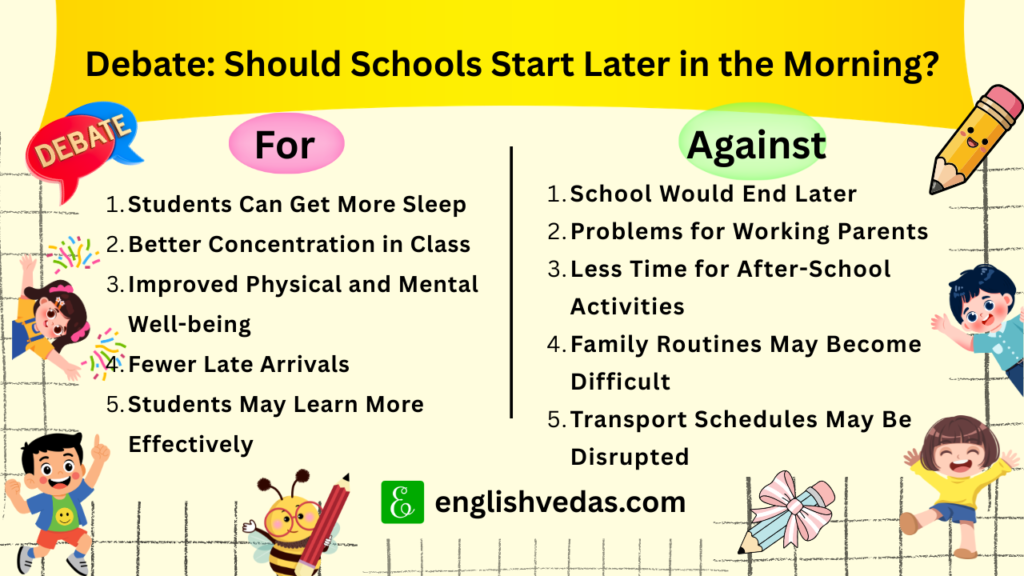
Should schools start later in the morning? School start times have become an important topic of debate in 2026 because they can affect students’ sleep, concentration, academic performance, and daily routines. Supporters of later school start times argue that students may benefit from getting more sleep and arrive at school better and concentrate in class. However, starting school later can also create challenges for parents, school transportation, after-school activities, and less family time. In this debate, we will explore the main arguments for and against starting school later and consider how a change in school timings could affect students, parents, and schools.
Points For the Debate (Debate: Should Schools Start Later in the Morning?)
- Students Can Get More Sleep
A later start gives students more time to sleep, helping them feel rested and ready to learn.
Students are deprived of the sleep they desperately need. They are in their growth years. We wake them up before their natural biological clock tells them that they are ready. Good sleep is associated with learning, memory consolidation, and emotional processing. They don’t get the 8 to 10 hours of sleep recommended by paediatricians, which leads to deep deprivation. Some children can’t think straight and become irritable.
- Better Concentration in Class
Well-rested students may find it easier to concentrate, participate, and understand lessons. Getting the right amount of sleep can help lower cortisol, a stress hormone. If school starts at 8:30 a.m., it may give students more time to get 8 to 10 hours of sleep. Students who sleep well at night generally have longer attention spans. They are also in a better mood to study and can focus more in class without getting easily distracted.
- Improved Physical and Mental Wellbeing
Extra morning sleep can help students feel less tired and stressed during the school day. Children are more likely to be obese if they don’t get enough sleep. Good sleep improves their immune system. Recent studies show that children who get less than 8 hours of sleep are more likely to develop a cold than those sleeping more than 7 hours a night. During puberty, youth undergo a shift in their circadian clocks that makes it harder for them to fall asleep until later in the night. - Fewer Late Arrivals
Students who struggle with early mornings may find it easier to get to school on time. It is stressful for students to be late for school. They wake up late or miss the bus. Sometimes they take too long to get ready. They might miss important lessons in school. To avoid being late, they should prepare school things the night before. Good time management will help them to be on time. Most of the students don’t miss first-period lessons. Hence, it leads to improved attendance. Students who go to bed later wake up later. Punctuality will make them responsible and disciplined. - Students May Learn More Effectively
Starting later could help students begin the school day with greater alertness and energy. When we force our child to get up early, they get stressed. Study time should be made enjoyable. The focus should be on learning and not on starting classes very early in the morning. Schools make children academically intelligent. Students learn better if school starts late because the schedule aligns with adolescent biological sleep rhythms. They showcase improved memory and concentration.
Points Against the Debate (Debate: Should Schools Start Later in the Morning?)
- School Would End Later
A later start would usually mean a later finishing time, leaving less time for homework, sports, and other activities. If school starts late, this would shift the entire school day. They will end up having fewer daylight hours for relaxing or socializing. During winter, late school hours become a safety concern for those walking and waiting for buses. They may have less time for extracurricular activities. - Problems for Working Parents
Parents who need to leave for work early may find it difficult to manage childcare in the morning. Late school timings are challenging for working parents. Parents who leave home for the office at 8.00 am cannot leave their younger children at home alone. They have to hire a babysitter which increases their financial burden. They get less quality time to spend with their kids. They end up relying on elder siblings to watch their younger brothers or sisters. Often, parents are concerned about their children’s safety because they are unable to drop them off at school. This can cause stress and affect their work life. Transport Schedules May Be Disrupted
School buses and public transport may need to be reorganised, creating additional practical difficulties. - Less Time for After-School Activities
Sports, clubs, tuition and other activities could finish later and interfere with students’ evening routines. If school starts later, it impacts the students’ participation in other activities. A research paper on “Changing school start times: Impact on extracurricular activities and employment” by Liza J Meltzer, Amy E Plog, Kyla L Wahlstrom, and Janise McNally highlights the impact of later school start times.
Research shows that with later school start times, middle and high school students had a small decrease in after-school activity participation (~3–4%).
Playing in daylight is essential as it improves students’ physical health and mental well-being. It increases alertness and concentration. It also helps them to retain information for a longer period.
- Family Routines May Become Difficult
A later school schedule could affect meal times, family time, and students’ bedtime routines.
If school starts later, students have a lot on their plates in the evening. They get less time to spend with their family members and may have to do their homework later in the evening. Families with more than one child in different schools might struggle to coordinate their schedules, which can make it difficult for the children to keep up with their studies. Some students also take tuition classes late in the evening, and by the time their day ends, they are completely exhausted. They are left with little or no time for themselves.
5. Transport Schedules May Be Disrupted
When school starts later, school buses are forced to be on the roads during peak hours. Students spend more time travelling by bus. There may be an increased risk of accidents if bus drivers try to drive faster. Schools may also have to hire more buses to accommodate students. If a student misses the school bus, they may not be able to attend class. Schools have to deal with the challenges of fewer routes and fewer drivers. Some students who do not use the school bus service may also struggle to reach school on time due to rush-hour traffic. Some schools do not offer school bus facilities for specially-abled children, who have to be dropped off and picked up from school by their parents.
Also Read:
- Should Students Be Allowed to Use AI Tools for Assignments? | Pros and Cons | Debate
- The Great School Uniform Showdown:Why the ‘Should School Uniform Be Mandatory’ Debate 2026
- Should Social Media Have a Minimum Age of 16? |Debate
- Exploring the Controversial Debate on Social Media Vetting in Today’s Digital Age: 4 Points
- Artificial Intelligence: A Boon or a Bane for Students? |Debate 2026
- Can Artificial Intelligence Replace Human Intelligence?| Best Debate 2026
- Debate: Are Friends Better Than Family in Today’s Modern Life?| Points For and Against 2026

My name is Sukhjit Kaur, and I am an English educator with 17+ years of experience helping students master grammar and writing. Through EnglishVedas.com, I simplify English grammar using examples from daily life and classrooms. I’ve been analyzing English media for 17 years to help students understand how grammar lives in the real world.