
Future Continuous Tense — Quick Rule
Subject + will be + verb-ing + object
Use it when an action will be in progress at a particular time in the future.
Example:
At 8 p.m. tomorrow, I will be studying.
Time Expressions: at 8 p.m. tomorrow, this time tomorrow, this time next week, when you arrive, at that time
This article is about the Future Continuous Tense and its 100 examples, which are explained in detail with the structure.
What is the Future Continuous Tense?
The Future Continuous Tense refers to an action going on at some time in the future.
Example: I shall be writing a book then.
When I get home, my children will be sleeping.
Future Continuous Tense means ‘I will be in the middle of doing something.’
For example: The film begins at 3.00 pm and ends at 5.30 pm. So, at 4.00 pm, I will be watching the film.
What is the Structure of the Future Continuous Tense?
At 9 o’clock tomorrow, Sue will be in the park. She will be walking.
She + will be +verb-ing
(subject) + (helping verb) + (walking)
This is an action (walking) that will be in progress at a specific time in the future.
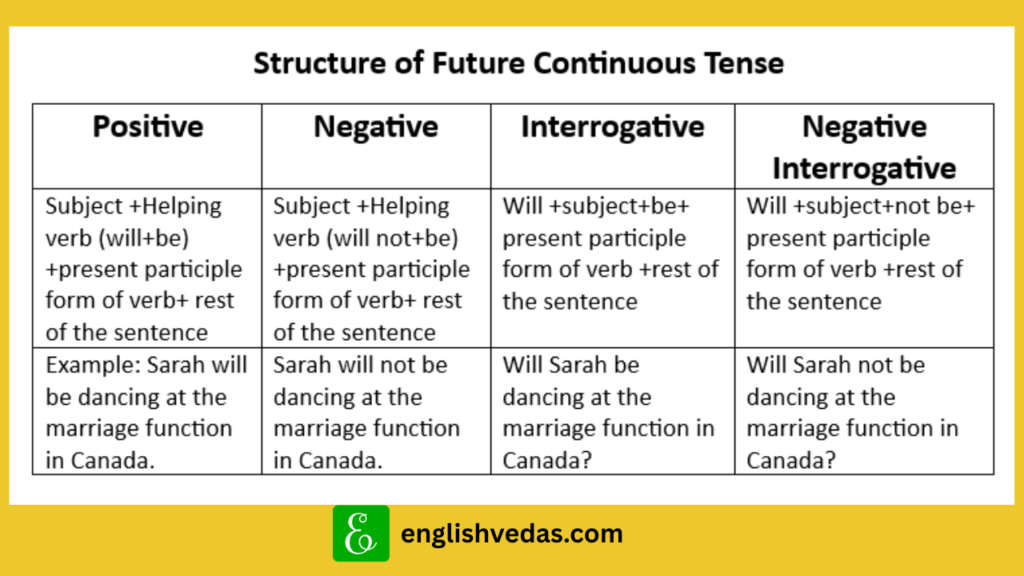
Structure of Future Continuous Tense
| Positive | Negative | Interrogative | Negative Interrogative |
| Subject +Helping verb (will+be) +present participle form of verb+ rest of the sentence | Subject +Helping verb (will not+be) +present participle form of verb+ rest of the sentence | Will +subject+be+ present participle form of verb +rest of the sentence | Will +subject+not be+ present participle form of verb +rest of the sentence |
| Example: Sarah will be dancing at the marriage function in Canada. | Sarah will not be dancing at the marriage function in Canada. | Will Sarah be dancing at the marriage function in Canada? | Will Sarah not be dancing at the marriage function in Canada? |
What do you use the Future Continuous Tense for?
- When we want to talk about an ongoing action at a specific time in the future.
Example: This time next week, I will be participating in the drawing competition.
- When we refer to a temporary action in the future. It denotes an action that will happen for a limited time; hence, it is not permanent.
Example: The soldier will be staying with his family for two weeks.
- When we want to ask a question about future plans, we use the future continuous tense.
Example: Will you be having a cup of tea for breakfast tomorrow?
- When two actions are happening at the same time in the future.
Example: While I will be reading a book, my sister will be cooking.
Future Continuous Tense vs Simple Future Tense
| Simple Future Tense | Future Continuous Tense |
| I will watch television at 5.00 pm. | I will be watching television at 5.00 pm. |
| It focuses on the future action. | It tells us about an action in progress in the future. |
10 Examples of Simple Future Tense and Future Continuous Tense
| Simple Future Tense | Future Continuous Tense |
| I will buy a doll tomorrow morning. | I will be buying a doll tomorrow morning. |
| I will do my homework at 7.00 pm. | I will be doing my homework at 7.00 pm. |
| He will go to school tomorrow at 8.00 am. | He will be going to school tomorrow at 8.00 am. |
| Ravi will play football at 3.00 pm tomorrow. | Ravi will be playing football at 3.00 pm tomorrow. |
| She will watch television in the evening. | She will be watching television in the evening. |
| Tina will study at night. | Tina will be studying at night when you come. |
| Rahul will attend the meeting tomorrow. | Rahul will be attending the meeting tomorrow at 3.00 pm. |
| We will drive to Delhi tomorrow. | We will be driving to Delhi at this time tomorrow. |
| John will read a book at 9.00 pm. | John will be reading a book at 9.00 pm. |
| He will work tomorrow. | He will be working at 10.00 am tomorrow. |
The Future Perfect Tense, on the other hand, is used to describe an action that will have been completed before a particular time in the future. Learn its structure and examples to understand how it differs from the Future Continuous Tense.
A. Actions happening at a specific future time
These are the strongest examples for showing an action in progress at a particular future time.
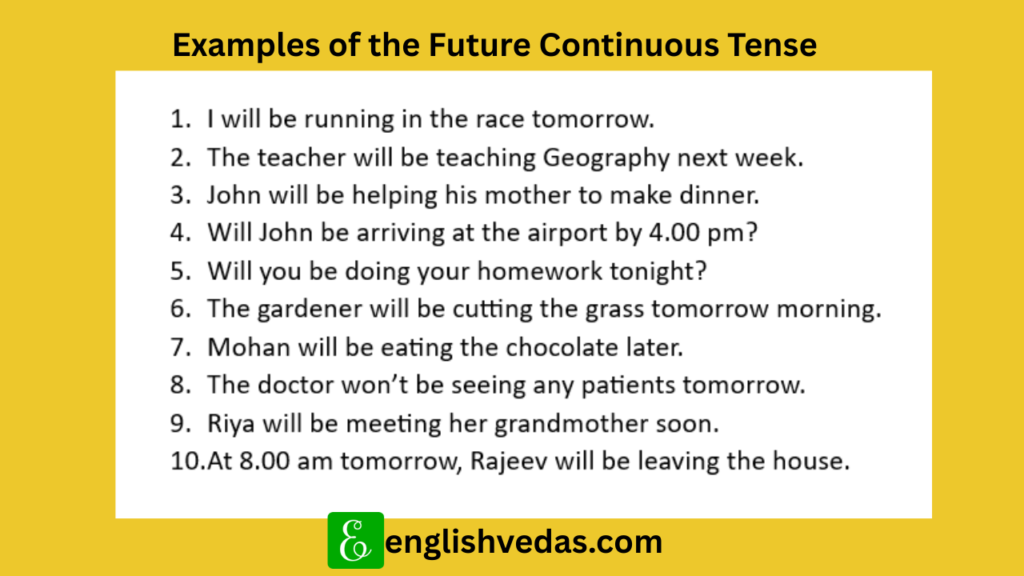
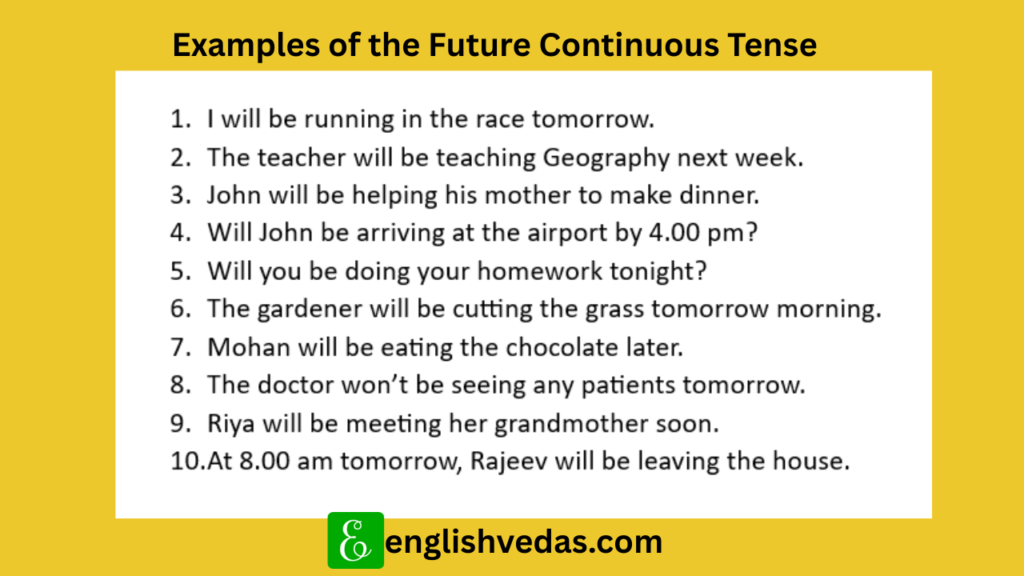
- At 8.00 am tomorrow, Rajeev will be leaving the house.
- The sun will be shining in the sky in the afternoon.
- At 7 pm tomorrow, I will be listening to music.
- It will be getting dark by 8 pm.
- At 8 pm on Monday, she will be preparing dinner.
- Diane will be studying at 7 pm tonight.
- I will be teaching at 2 pm tomorrow.
- Tom will be going to the market at 11 am tomorrow.
- The maid will be doing the housework at 9 am.
- At 4 o’clock tomorrow, I will be explaining the lesson to students.
- Samuel will be listening to the radio at 3 pm tomorrow.
- Rajeev will be washing the pile of clothes at 6 pm.
- She will be praying at 6 am tomorrow, so don’t call her then.
- They will be paying school fees at 10.00 am tomorrow.
- She will be parking her car in the garage at 8.00 pm tomorrow.
- Will they be sleeping at 9.00 pm?
- Will Julia be checking the exam sheets then?
- Will he be waiting for his mother at the station?
- You can call us between 6 and 7. We won’t be having dinner then.
- Sally will be walking home from school at 2.00 pm.
- At 10 a.m. tomorrow, the students will be taking their English test.
- This time tomorrow, I will be travelling to Chandigarh.
B. Two actions happening simultaneously
These are particularly useful because they demonstrate two future actions happening at the same time.
- John will be helping his mother to make dinner.
- When you go into the class, Amelia will be sitting at the front desk.
- Mr. and Mrs. Gupta will be waiting for you when you get back tomorrow.
- When we become members of Lion’s Club, we will be helping the people in need.
- When the teacher leaves the class, the children will be making noise.
- I will be having a cup of tea when you come.
- I will be playing badminton on Friday and my sister will be playing chess.
- When the clock strikes midnight, we will be sleeping.
- The students will be speaking to the school principal, and you will be attending the annual day function.
- Manpreet will be working on her project when you reach her place.
- My brother will be watching TV, and I will be writing an essay.
- When the teacher teaches History, some students will be trying to stay awake.
- What will you be doing when you reach the science museum?
- I will not be taking notes when you come.
- While my mother is preparing dinner, I will be setting the table.
- When you arrive home, your brother will be watching television.
C. Future arrangements / questions
This section is useful for showing Future Continuous in questions, planned activities and expected future activities.
- Will John be arriving at the airport by 4.00 pm?
- Will you be doing your homework tonight?
- Riya will be meeting her grandmother soon.
- Will you be watching a movie tonight?
- Will you be going to school tomorrow?
- Will she be speaking French?
- Which dress will you be buying?
- How will Mohan be going to the office tomorrow?
- Will you be making tea after an hour?
- She will be riding a horse next Monday.
- They will be giving clothes to the poor next week.
- James will be selling his car next month.
- He will be listening to the news this evening.
- The mechanic will be repairing the car tomorrow morning.
- Will it be raining tomorrow?
- Will Jack be playing baseball tomorrow?
- Sophia will be taking her music lesson in the morning.
- He will be attending a convention next month.
- Will Ava be waiting for me?
- Will you be working tomorrow?
- Jack and Jill will be going to a wedding ceremony next Thursday.
- I will be borrowing books from the library this afternoon.
- Olivia will be going to the mall next Tuesday.
- I will be studying at my friend’s house tonight.
- They will be going around the village in search of the thief.
- She will be going on a trip to Goa next Sunday.
- You will be playing golf this Sunday.
- Will you be eating Chinese food tomorrow?
- Will you be attending the school meeting next Monday?
D. Temporary future situations
These work best when the action describes something that will continue for a period of time in the future, rather than happening at just one particular moment.
- Today we are taking a cab, but next week we will be taking the bus.
- We will be visiting South Africa next week.
- He will be studying hard tonight.
- She will not be buying a new phone next week.
- Charlotte will be writing a book this time next month.
- They will be playing video games on Saturday.
- He will be driving to Delhi tomorrow morning.
- The workers will be building the bridge next year.
- My parents will be flying a plane next October.
- The boys will be collecting money for the orphanage tomorrow.
- In an hour, I will be washing my clothes.
- I will be working as a salesman from July to August.
- Our college will be hosting a special event next November.
- Ten years from now, I will be working in a multinational company.
- We will be living in London in 2030.
- They will be writing a letter to each other next year.
- I will be publishing a book next year.
- She will be organizing the books in her cupboard.
- I will be cutting the grass tomorrow.
- They will be turning off the lights in an hour.
- Ann will be eating a lot of fruits.
- Margaret will not be feeding the dogs at 9.00 am.
Read More:-
- English Vedas Blog
- At On In: Difference Worksheet Exercises That Make Learning Easy and Simple!
- “Going to” Exercise Examples and Sentences
- Uses of Used to Exercises, Examples, Sentences in English Grammar
- Active and Passive Voice: Worksheet with 100 Examples, Answers, Differences, and Rules Revealed!
- ‘There Is or There Are’ 100 Sentences Worksheet Examples to Boost Your Grammar Skills!
- Mastering ‘Will’ vs. ‘Shall’ : Difference, Use, Rules, and Mind-Blowing Examples
- Future Perfect Tense Worksheet with Answers (Free PDF Download)
- 100 Simple Future Tense Example Sentences with Structure and Usage
- 30 Future Perfect Continuous Tense Examples + Free Worksheet with Answers
- The Future Perfect Tense: 100 Examples Sentences |Structure & Their Formula!|

My name is Sukhjit Kaur, and I am an English educator with 17+ years of experience helping students master grammar and writing. Through EnglishVedas.com, I simplify English grammar using examples from daily life and classrooms. I’ve been analyzing English media for 17 years to help students understand how grammar lives in the real world.