
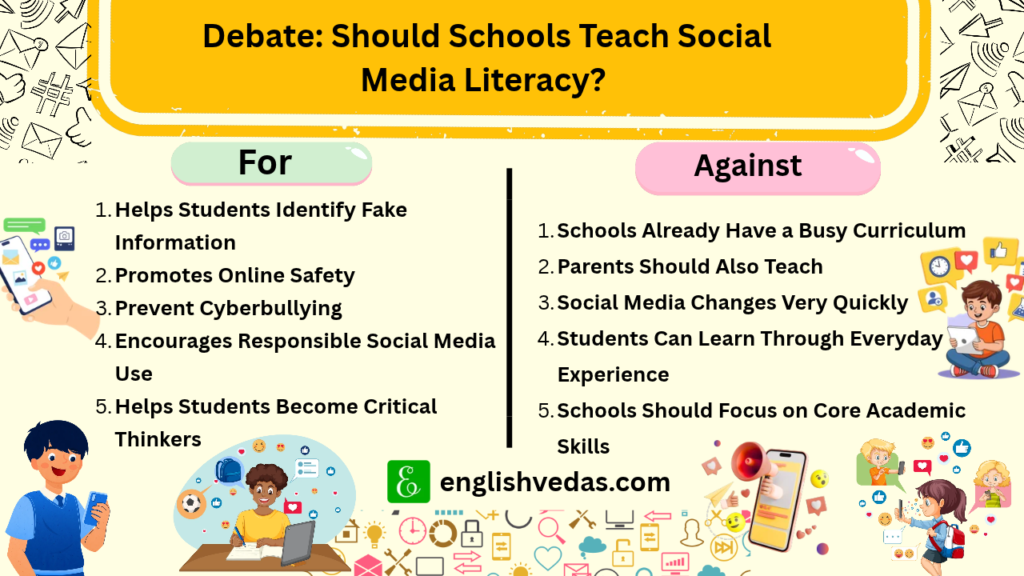
Social media literacy has become an important skill for students growing up in a digital world. Children use social media to learn, communicate, share ideas and connect with others, but they can also encounter misinformation, cyberbullying, privacy risks and online manipulation. This raises an important question: Should schools teach social media literacy? In this debate, we explore why social media literacy should—or should not—be part of school education and how it can help students become responsible and informed digital citizens.
Against: Should Schools Teach Social Media Literacy?
- Schools Already Have a Busy Curriculum
A Curriculum is the complete plan of learning experiences provided by a school or educational institution. It includes learning objectives, content or subjects, teaching strategies, learning activities, assessment methods, and even values and attitudes.
Students have many subjects to study, and they also engage in extracurricular activities. Some of the students also take tuition classes as they find some of the subjects difficult. Adding another subject of social media literacy will add to their burden. For instance, the Central Board of Secondary Education focuses on theoretical knowledge and mathematics. ICSE and ISC has a emphasizes on English language and learning through projects.
2. Parents Should Also Teach Responsible Social Media Use
Parents play an important role in guiding children about online behaviour, privacy, and safety. These lessons do not have to be taught entirely at school.
It is important for parents to keep their communication channels open with students. They should talk to their children without being judgemental. They can ensure that they use social media in limits and keep phones out of bedrooms or dining tables.
When parents take the onus on their shoulders by modelling good behaviour themselves. They can also teach children to locate misinformation and protect their personal data.
As parents, we should not allow them unlimited access without proper guidance. They can make their children aware to protect themselves from inappropriate content, strangers, peer pressure, and unhealthy comparisons. Parents should know what platforms their children are using. By keeping the channels of communication open, they can make kids comfortable talking to them if something online makes them uncomfortable. Therefore, schools are not solely responsible for teaching social media literacy.
3. Social Media Changes Very Quickly
New platforms, trends, and features appear frequently. What students learn today may become outdated in a short time.
Algorithms drive social media. It shifts according to virality. It shows content based on behaviour rather than who you follow. The impact of artificial intelligence and automation on social media has been phenomenal. It is now much more than just a medium for connecting with friends, relatives, and family members. It is a crucial part of the internet world, which also shapes careers and behaviours. Social platforms are now search engines that focus on content creators.
Whatever students learn today about social platforms may become obsolete tomorrow. The curriculum and teaching methodology need to be adjusted accordingly.
4. Students Can Learn Through Everyday Experience
Many students already use social media regularly and can learn about responsible use through practical experience, discussions, and guidance from adults.
We learn through traveling, but we can’t always travel, so the primary way to learn is through social media. If your social media is filled with posts about trauma and toxicity, children will view the world as a negative place. However, if your social media is filled with posts and content that align with your goal, children will view the world as a positive place.
Children get real-time exposure to diverse cultures and global perspectives. Through social media, they can learn about different people’s views, opinions, and experiences. Students also have opportunities to interact with mentors and peers through live sessions. Moreover, hands-on experience with real-time projects can help them develop confidence, communication skills, and a better understanding of the world around them.
5. Schools Should Focus on Core Academic Skills
Mathematics is an indelible part of everything we do. It is an essential part of being human. As we are making ourselves into a progressive modern society that relies on technology then it is important for them to become mathematical thinkers. Children are taught science because there are many things in the world that cannot be understood by simple observation; questions like what causes electricity, how birds fly, or whether the universe is infinite can be answered by studying science. Schools teach English, science, mathematic to children to make their foundational skills strong. Therefore, adding another subject of social media literacy will distract them from strengthening their foundational skills.
For: Should Schools Teach Social Media Literacy?
- It Helps Students Identify Fake Information
Students can learn how to recognise fake news, misleading posts, edited images, and unreliable sources online.
Children are increasingly exposed to manipulated content online. The rise of social media and AI has increased the spread of misinformation. These days, kids know to question the sources of news stories. AI technology creates fake images and videos, making it more challenging to detect the truth. Hence, schools should teach them how to verify facts and recognise manipulated data. It is important to teach them digital literacy. Students can be taught how to find facts in a fun way. It can make them aware of how to spot AI-generated content.
2. It Promotes Online Safety
Social media literacy can teach students how to protect their personal information, passwords, photos, and privacy.
Children should be taught how to protect their privacy and use appropriate privacy settings on social media platforms. They should understand the importance of not sharing personal information, photographs, or other sensitive details online.
3. It Can Prevent Cyberbullying
Students can learn how to recognise cyberbullying, respond responsibly, and report harmful behaviour.
Schools can also teach students how to identify misinformation and avoid being manipulated or misled by false content. In addition, students should learn how to recognise cyberbullying, respond to it responsibly, and take appropriate steps to report and combat it.
Children should be taught to distinguish between genuine and harmful messages. They should recognise messages that hurt and jokes that go wrong. This prevents them from sharing harmful content online. Gen Z and Gen Alpha spend a lot of time on social media, so social media literacy is essential for them. Some posts are designed to generate hate, anger, and spread negativity. This shows how such harmful ideas can lead to cyberbullying. They understand when someone is being mean or unfair.
4. It Encourages Responsible Social Media Use
Students can understand that their online actions have consequences and learn to think carefully before posting or sharing something.
The idea behind media literacy is to create a safer environment online. Digital literacy promotes mindful consumption of social media content. It motivates them to follow digital ethics by communicating respectfully online. They are made aware of the long-term impact of their digital footprint, spot scams, configure strict privacy settings, and secure accounts.
5. It Helps Students Become Critical Thinkers
Social media exposes young people to enormous amounts of information. Learning to question, verify, and evaluate what they see can help them make better-informed decisions.
These days, students come across a vast amount of information from different sources. Unfortunately, not every piece of information is reliable. Social media literacy will force children to question who created the post and what were the intentions of the person behind creating it. Whenever they come across a message or a post, they will be able to spot the hidden biases or manipulation behind it. They should be taught that they should focus on connecting to learn rather than wasting time in passive scrolling. Critical thinking is essential for children as it protects their mental health.
Also Read:-
- Should Social Media Have a Minimum Age of 16? |Debate
- Exploring the Controversial Debate on Social Media Vetting in Today’s Digital Age: 4 Points
- The Great School Uniform Showdown:Why the ‘Should School Uniform Be Mandatory’ Debate 2026
- Should Students Be Allowed to Use AI Tools for Assignments? | Pros and Cons | Debate
- Debate: Should Schools Start Later in the Morning? in 2026
- Best Debate: Online Learning vs Traditional Classroom Learning

My name is Sukhjit Kaur, and I am an English educator with 17+ years of experience helping students master grammar and writing. Through EnglishVedas.com, I simplify English grammar using examples from daily life and classrooms. I’ve been analyzing English media for 17 years to help students understand how grammar lives in the real world.