
Conjunctions Exercise for Class 7: Types, Examples, and Answers
This article explains what conjunctions are and the types of conjunctions for Class 7 students. It contains exercise of conjunctions for Class 7 students so that they can practice and learn the use of different types of conjunctions in English grammar. It contains answers so that students can check after attempting the exercise.
What are conjunctions?
A conjunction is a word that is used to join words or sentences together.
Conjunctions make sentences meaningful and are used to connect ideas.
Types of Conjunctions with Examples
There are two types of conjunctions:
- Coordinating Conjunctions
- Subordinating Conjunctions
- Correlative Conjunctions
- Coordinating Conjunctions – The conjunctions that are used to join sentences of equal rank or order together is a coordinating conjunction.
FANBOYS – For, And, Nor, But, Or, Yet, So.
Example:
- The boy ran. The boy fell.
The boy ran and the boy fell.
- Jaya has failed. Tina has passed.
Jaya has failed but Tina has passed.
- Study hard. You will fail.
Study hard or you will fail.
- She is intelligent. She is sad.
She is intelligent yet she is sad.
- He is poor. People love him.
He is poor still people love him.
- She stayed at home. It was raining heavily.
She stayed indoors, for it was raining heavily.
- He did not read a book. He did not sleep.
He did not read a book, nor did he sleep.
Take the first pair of sentences. The sentences ‘The boy ran’ and ‘The boy fell’ are two independent sentences. They can stand alone. The are of equal rank. They don’t depend on each other for its full meaning. When we join these sentences with the conjunction and, ‘The boy ran and the boy fell.’
Hence in the above sentences the words for, and, nor, but, or, yet, still are coordinating conjunctions.
- Sub-ordinating Conjunctions (Correlative Conjunctions) – these are conjunctions that are used in pairs.
Example:
- Either ….. or.
- Neither …..nor.
- Both…and.
- Though…..yet.
- Not only…… but also.
- So…..that.
- Hardly……when.
- No sooner……than.
- Either take tea or take coffee.
- He is neither thirsty nor hungry.
- We both loved and honoured him.
- Though he is sick, yet he is active.
- She not only cleaned her room but also decorated it with flowers.
- He was so lazy that he did not even get up from his bed.
- John had hardly reached the bank when it began to rain.
- No sooner did the taxi arrive than the girls ran out of their hostel.
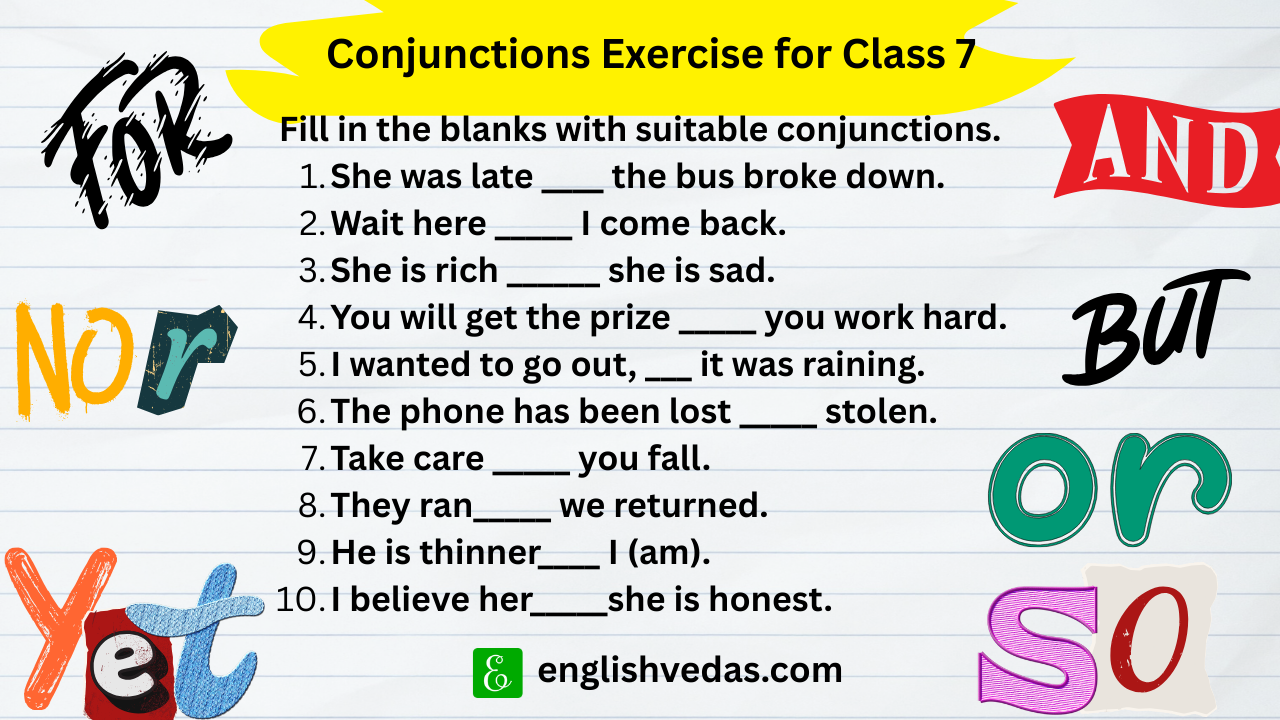
Conjunctions Exercise for Class 7
Exercise 1: Fill in the blanks.
Fill in the blanks with suitable conjunctions.
- She was late ____ the bus broke down.
- Wait here _____ I come back.
- She is rich ______ she is sad.
- You will get the prize _____ you work hard.
- I wanted to go out, ___ it was raining.
- The phone has been lost _____ stolen.
- Take care _____ you fall.
- They ran_____ we returned.
- He is thinner____ I (am).
- I believe her_____she is honest.
Answers
1. She was late because the bus broke down.
2. Wait here till I come back.
3. She is rich but she is sad.
4. You will get the prize if you work hard.
5. I wanted to go out, but it was raining.
6. The phone has been lost or stolen.
7. Take care lest you fall.
8. They ran when we returned.
9. He is thinner than I am.
10. I believe her because she is honest.
Common Errors in the Use of Conjunctions
| Incorrect | Correct |
| I want to know as to why you are late. | I want to know why you are late. |
| He asked me that why I was unhappy. | He asked me why I was unhappy. |
| Neither he comes nor he phones. | Neither does he come nor does he phone. |
| Both Rajesh as well as Aamir are studying hard for exams. | Both Rajesh and Aamir are studying hard for exams. |
| I have bought magazines, novels, storybooks, and etc. | I have bought magazines, novels, storybooks, etc. |
| She as well as you is intelligent. | She as well as you are intelligent. |
| No sooner I had complained than he took action. | No sooner had I complained than he took action. |
| She dresses herself like her mother does. | She dresses herself as her mother does. |
Conjunctions: A Newspaper Cutting Analysis

In this cutting from The Times of India (8th April 2026), notice the use of conjunctions in the first two paragraph.
As stated in the newspaper cutting, “Airstrikes pounded Tehran on Tuesday, and Iranian officials urged young people to form human chains to protect power plants.” Here, the conjunction ‘and’ is used as the journalist has explained two different things in one line.
Furthermore, the journalist wrote, “US president Donald Trump’s latest deadline for the Islamic Republic to reopen the crucial Strait of Hormuz or face punishing strikes on the infrastructure.” Here, the conjunction ‘or’ is used by the journalist to explain two conditions.
In the second paragraph, the newspaper cutting states, “Trump has extended previous deadlines but suggested the one set for 8 pm in Washington was final.” The use of the conjunction ‘but’ clearly states the shift in the thought.
In the newspaper analysis I have explained the use of conjunctions and, or, and but.
In my daily teaching practice, I found that students learn faster when they are explained through newspaper cuttings, and they also develop the habit of reading.
In my 17 years of career, I have always motivated students to read newspapers and learn grammar concepts.
Also Read:-
- Artificial Intelligence: A Boon or a Bane for Students? |Debate 2026
- Understanding Infinitives: Uses of To and Without To | Simple Examples | 1 Exercise
- Complex Sentence Examples for Easy Grammar Learninghttps://englishvedas.com/complex-sentences/
- Determiners Worksheet with Answers PDF | Easy Exercises | Free Download
- Uses of Modals for Class 5 | May, Might, Can, Could, Should & More with Examples
- Use of This, That, These, Those – 30 Example Sentences Worksheet for Class 1 (With Answers)
- Debate on Can AI Replace Teachers?|5 Points For and Against

My name is Sukhjit Kaur, and I am an English educator with 17+ years of experience helping students master grammar and writing. Through EnglishVedas.com, I simplify English grammar using examples from daily life and classrooms. I’ve been analyzing English media for 17 years to help students understand how grammar lives in the real world.