
Nouns Definition Types Rules and Examples
Learning nouns is an essential part of English grammar. When we want to name persons, animals, places, or things, we use nouns.
On this page, you will learn the definition of a noun, its different types, important noun rules, and examples. You can also practise what you learn with our noun worksheets and exercises.
What is a noun?
A noun names a person, place, animal, thing, or quality.
Examples:
- Person: Ram, teacher, nurse
- Place: Park, New York, garden
- Animal: Cat, dog, monkey
- Thing: table, chair, pen
- Quality: Brave, honest, beautiful
- Feeling: happiness, sadness, fear
Examples in sentences:
- The teacher is helpful.
- He is going to Goa next week.
- The cat is sitting on the chair.
- I have a red pen.
- Honesty is an important quality.
The bold words are nouns because they name people, places, animals, things, or abstract concepts.
What Are the Different Types of Nouns?
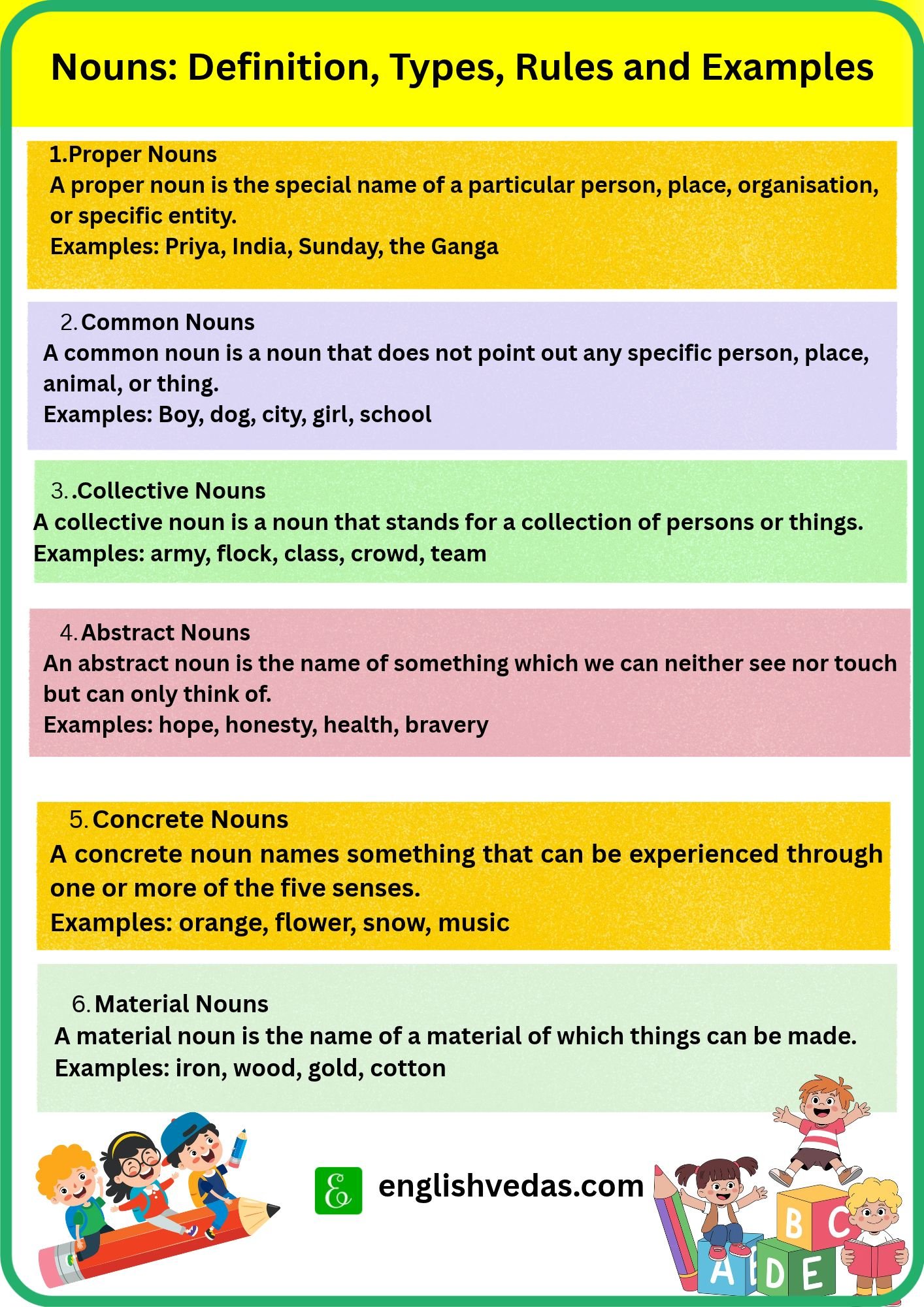
- Proper Nouns
A proper noun is the special name of a particular person, place, organisation, or specific entity.
Examples: Priya, India, Sunday, the Ganga
Sentence: Priya is an intelligent girl.
2. Common Nouns
A common noun is a noun that does not point out any specific person, place, animal, or thing.
Examples: Boy, dog, city, girl, school
Sentence: The boy is playing cricket.
3. Collective Nouns
A collective noun is a noun that stands for a collection of persons or things.
Examples: army, flock, class, crowd, team
Sentence: Our team won the football match.
4. Abstract Nouns
An abstract noun is the name of something which we can neither see nor touch but can only think of.
Examples: hope, honesty, health, bravery
Sentence: Truth can clear all doubts.
5. Concrete Nouns
A concrete noun names something that can be experienced through one or more of the five senses.
Examples: orange, flower, snow, music
Sentence: The rain feels refreshing.
6. Material Nouns
A material noun is the name of a material of which things can be made.
Examples: iron, wood, gold, cotton
Sentence: The gold ring is expensive.
Important Rules of Nouns
Rule 1: Proper nouns begin with capital letters.
A proper noun always begins with a capital letter.
Example:
- My classes start in January.
- They live in Goa.
- Rahul is a hardworking boy.
Rule 2: Singular nouns name one; plural nouns name more than one.
A noun that denotes one person, one thing, or one place is said to be a singular noun.
A noun that denotes more than one person, place or thing is said to be a plural noun.
Examples:
- Sister – sisters
- House – houses
- Eye – eyes
- Box – boxes
- Cow – cows
Rule 3: Many plural nouns are formed by adding -s or -es.
- By adding ‘s’ to the singular form.
Example:
- Lion – lions
- Spoon – spoons
- Nouns ending in s, sh, ss, ch, x or z become plural by adding ‘es’ to them.
Example:
- Tax – taxes
- Glass – glasses
- Nouns ending in ‘y’ and preceded by a vowel become plural by adding ‘s’ to them.
Example:
- Day – days
- Monkey – monkeys
- Nouns ending in ‘o’ and preceded by a vowel become plural by adding ‘s’ to them.
Example:
- Bamboo – bamboos
- Studio – studios
- Nouns ending in ‘o’ and preceded by a consonant become plural by adding ‘es’ to them.
Example:
- Hero – heros
- Tomato – tomatoes
- Nouns ending in ‘f’ or ‘fe’ become plural by changing ‘f’ or ‘fe’ into ‘ves’.
Example:
- Knife – knives
- Half – halves
- Nouns ending in ‘y’ become plural by changing ‘y’ into ‘ies’.
Example:
- Lady – ladies
- Fly – flies
Rule 4: Some nouns are uncountable
Uncountable nouns are nouns that cannot be counted or are usually not counted, e.g., Water, milk, flour, smoke.
Rule 5: Possessive nouns show ownership or relationships
Possessive nouns are formed by adding an apostrophe and s (‘s’) to singular Nouns and plural nouns (not ending in s) that have life.
Example:
- the boy’s shirt
- My brother’s phone
- the children’s toys
Rule 6: Nouns must fit the meaning and grammar of a sentence
Examples:
- The boy plays cricket.
- The boys play cricket.
Practice with Noun Worksheets
Understanding the rules is the first step. Practice helps you recognise nouns and use them correctly in sentences.
- Worksheets of Nouns for Class 1
- Collective Nouns Worksheet for Class 2 (With Answers)
- Countable and Uncountable Nouns Worksheet with Answers for Class 3–5 | Free PDF
These worksheets provides structured practice in identifying and using nouns. It helps in understanding nouns definition types rules and examples.

My name is Sukhjit Kaur, and I am an English educator with 17+ years of experience helping students master grammar and writing. Through EnglishVedas.com, I simplify English grammar using examples from daily life and classrooms. I’ve been analyzing English media for 17 years to help students understand how grammar lives in the real world.