
Noun clauses are a crucial part of English grammar and frequently appear in school exams and competitive tests. A noun clause is a subordinate clause that performs the function of a noun in a sentence. In this lesson on Noun Clause Examples with Answers, you will learn how noun clauses are used in complex sentences as the subject of a verb, object of a verb, object of a preposition, complement of a verb of incomplete predication, and in apposition to a noun or pronoun.
This article includes clear definitions, well-explained examples, solved exercises, and practice questions to help students strengthen their understanding of noun clauses and improve accuracy in grammar, writing, and examinations.
A subordinate clause that does the work of a Noun in a sentence is called a Noun Clause.
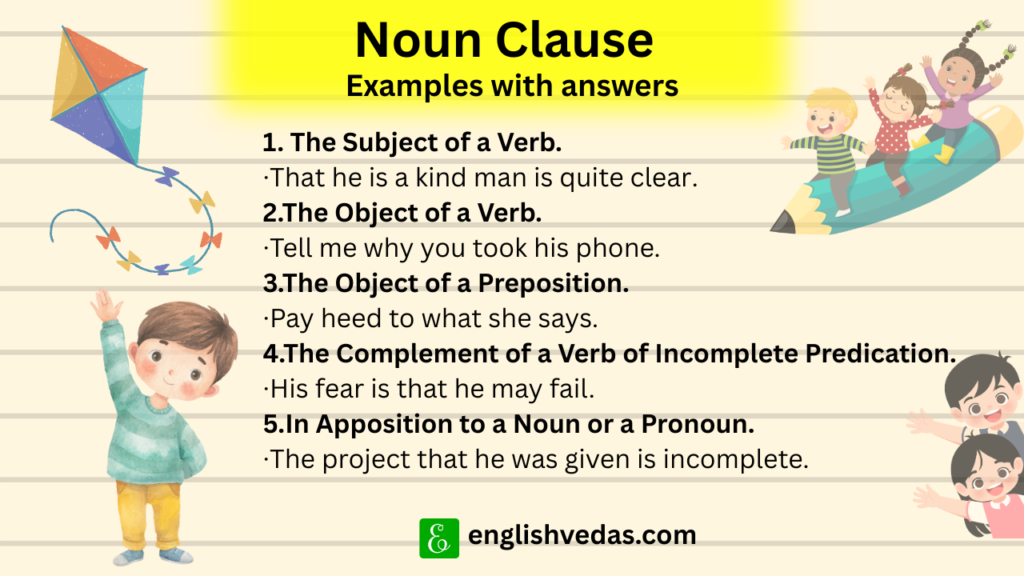
A noun clause does the work of a noun in a complex sentence, so it can be,
- The Subject of a verb.
- The Object of a verb.
- The Object of a preposition.
- The Complement of a verb of Incomplete Predication.
- In Apposition to a Noun or a Pronoun.
- The Subject of a verb.
In the following complex sentences, the Noun Clause is the Subject of a verb. Examples:
- When she will return the money is not known.
- That he is a kind man is quite clear.
- What he says is quite false.
- Why she went is a mystery.
- The Object of a verb.
In the following complex sentences, the Noun Clause is the Object of the verb. Examples:
- Tell me where did he go.
- Tell me why you took his phone.
- No one knows where she stays.
- I do not know when they will return.
- I believe that she has told the truth.
- The Object of a preposition.
In each of the complex sentences below, the Noun Clause is the object of a preposition. Examples:
- Pay heed to what she says.
- He was dissatisfied with what I did.
- I do not believe in what they say.
- All depends on how it is cooked.
- The Complement of a verb of Incomplete Predication.
In each of the following complex sentences, the Noun Clause is used as the complement of a verb of incomplete predication. Examples:
- His fear is that he may fail.
- My wish is that I may serve her.
- She believes that honesty is the best policy.
- Life is what we make it.
- In Apposition to a Noun or a Pronoun.
In the following complex sentences, the Noun Clause is in apposition to a noun or a pronoun. Examples:
- The project that he was given is incomplete.
- Your statement that he loves meat is false.
- It is worrisome that she would do so.
- It is clear that she was innocent.
- It was unfortunate that he was dishonest.
Noun Clause Exercise with Answers
Complete the following sentences by adding a suitable Noun Clause.
- He answered__________.
- __________surprise me.
- I believe_________.
- They knew__________.
- Does he know__________.
- It is certain_________.
- He told me__________.
- He was happy with______________.
- Tell her_________.
- No one knows_______.
Answers:-
- He answered that he was guilty.
- That she should say so surprises me.
- I believe that he will pass.
- They knew what the outcome would be.
- Does he know where she studies?
- It is certain that he will fail.
- He told me that he would buy later.
- He was happy with what he had got.
- Tell her what you have felt.
- No one knows where he went.
Noun Clause Exercise 2 with Answers
Exercise
Pick out the Noun Clause in each of the following sentences:-
- He thinks that he will win the match.
- It is not known where she went.
- He asked me whether my sister was in school.
- I believe he will tell the truth.
- It is certain that he will fail.
- That she should think so surprises me.
- The news that he met with an accident is untrue.
- The truth is that they have been misled.
- It is not known who has taken your umbrella.
- There is no meaning in what he says.
Answers:-
Here are the answers with the noun clauses clearly picked out:
- He thinks that he will win the match.
- It is not known where she went.
- He asked me whether my sister was in school.
- I believe he will tell the truth.
- It is certain that he will fail.
- That she should think so surprises me.
- The news that he met with an accident is untrue.
- The truth is that they have been misled.
- It is not known who has taken your umbrella.
- There is no meaning in what he says.
People Also Ask:-
1. What is a noun clause?
A noun clause is a group of words that has a subject and a verb that does the work of a noun in a sentence. It can act as a subject, object, or complement.
For Example: What she says he quite true.
2. How can I identify a noun clause in a sentence?
A noun clause often begins with words like that, what, who, whom, whether, if, why, or how. A noun or pronoun can replace these words without changing the sentence’s meaning.
Also Read:-
- Adverb Clauses Explained |Best Examples | 1 Exercise with Answers
- Conjunctions Exercise for Class 7 with Examples and Answers
- Artificial Intelligence: A Boon or a Bane for Students? |Debate 2026
- Understanding Infinitives: Uses of To and Without To | Simple Examples | 1 Exercise
- Complex Sentence Examples for Easy Grammar Learning
- Determiners Worksheet with Answers PDF | Easy Exercises | Free Download
- Uses of Modals for Class 5 | May, Might, Can, Could, Should & More with Examples

Written by Sukhjit Kaur, English educator with 17+ years of experience helping students master grammar and writing. Through EnglishVedas.com, she simplifies English grammar using examples from daily life and classrooms.