
This article explains what adverb clauses are, what the different types of adverb clauses, and contains an exercise with answers. The adverb clause examples are simple and easy to understand for the students.
What is an Adverb Clause?
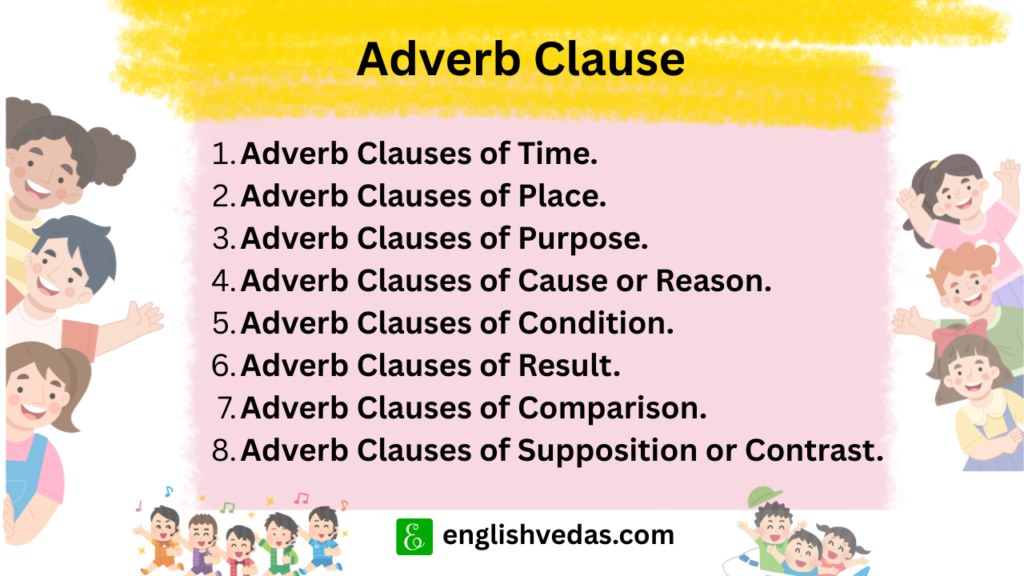
An adverb clause in a complex sentence does the work of an adverb. Adverb clauses are of many kinds.
- Time
- Place
- Purpose
- Cause
- Condition
- Result
- Comparison
- Supposition or contrast
- Adverb Clauses of Time
In it, the subordinating conjunctions when, whenever, while, before, after, till, since, as, etc. are used.
When the dog is away, the cat will play.
She praises him whenever she meets him.
Do not listen to music while you are studying.
Before you go, bring me a dictionary.
I will meet her after the class.
As soon as she heard the news, she was happy.
Just as he entered the class, the bell rang.
I have been worried since I returned from college.
2. Adverb Clauses of Place.
Adverb clauses of place are introduced when we use subordinating conjunctions such as where, whenever, whence, whither, etc.
I have hidden the chocolates where no one can find them.
Olivia makes friends whenever she goes.
You can call me whenever you like.
She returned to the village whence she had first learned the value of kindness.
No one knew whither the journey would end, but they continued travelling.
3. Adverb Clauses of Purpose
Adverb clauses of purpose are expressed by subordinating conjunctions like that and lest.
She studied hard that she might pass the exam.
He spoke slowly lest she should disturb others.
She slept lest she should be exhausted.
Take notes lest you forget what is taught in the class.
We eat that we may live.
4. Adverb Clauses of Cause or Reason.
Adverb clauses of cause or reason are introduced by the subordinating conjunctions because, as, that, and since.
I shall buy books because I like them.
I couldn’t attend the class yesterday because I was sick.
He thinks that, because he is clever, he can fool anyone.
As he was guilty, the court punished him.
I am glad that you liked what I wrote.
Since you are my friend, I shall help you.
5. Adverb Clauses of Condition
Adverb clauses of condition are introduced by the subordinating conjunctions if, whether, and unless.
If it snows, we shall stay at home.
If you eat too much, you will be ill.
He will not win the match whether or not he practices.
Unless she studies harder, she will fail.
I will forgive you on the condition that you don’t repeat your mistake.
6. Adverb Clauses of Result
Adverb clauses of result are introduced by the subordinating conjunction that. We use so and such before it in the principal clause.
She is so old that she can hardly stand up.
She is so helpful that everyone loves her.
The news is so good that it cannot be true.
He is such a good man that all respect him.
So carefully did he plan the project that nothing went wrong.
So loudly did they spoke that everyone heard them.
7. Adverb Clauses of Comparison
Adverbs clauses of comparison are of two kinds:
- Adverb Clauses of Comparison of Degree.
- Adverb Clauses of Comparison of Manner.
- Adverb Clauses of Comparison of Degree are introduced by the subordinating conjunction than, or by the Relative Adverb as;
She is more intelligent than she seems.
He studies harder than I do.
He is as clever as he is sharp.
He is not as hardworking as you think.
- Adverb Clauses of Comparison of Manner are introduced by the relative adverb.
It all ended as we expected.
As you sow, so shall you reap.
8. Adverb Clauses of Supposition or Contrast
They are introduced by the subordinating conjunctions though, although, even if.
Though he is rich, he is humble.
Although he was ill, he attended the class.
Though she lied to me yet, I will help her.
Even if he is thin, he is able to carry a lot of weight.
Even if it rains, we shall go to the market.
Although they fought bravely, they were defeated.
Exercise
Pick out the adverb clauses in the following sentences, and say of what kind of person each is:
- He is helpful than I am.
- Even if it rains, she will come.
- Though he is poor, he is happy.
- Because I like him, I shall help him.
- As he was ill, he could not attend his cousin’s brother’s wedding.
- Though he slay me, yet I will trust him.
- So terrible a disease broke out that very few people were alive.
- They worked hard that they might become rich.
- Wait till I return.
- He flatters her whenever he meets her.
Pick out the adverb clauses and state their kind:
- He is helpful than I am.
👉 Adverb clause: than I am
👉 Kind: Adverb clause of Comparison - Even if it rains, she will come.
👉 Adverb clause: Even if it rains
👉 Kind: Adverb clause of Condition - Though he is poor, he is happy.
👉 Adverb clause: Though he is poor
👉 Kind: Adverb clause of Concession - Because I like him, I shall help him.
👉 Adverb clause: Because I like him
👉 Kind: Adverb clause of Reason - As he was ill, he could not attend his cousin’s brother’s wedding.
👉 Adverb clause: As he was ill
👉 Kind: Adverb clause of Reason
Though he slay me, yet I will trust him.
👉 Adverb clause: Though he slay me
Also Read:-
- Conjunctions Exercise for Class 7 with Examples and Answers
- Artificial Intelligence: A Boon or a Bane for Students? |Debate 2026
- Understanding Infinitives: Uses of To and Without To | Simple Examples | 1 Exercise
- Complex Sentence Examples for Easy Grammar Learning
- Determiners Worksheet with Answers PDF | Easy Exercises | Free Download
- Uses of Modals for Class 5 | May, Might, Can, Could, Should & More with Examples
- Use of This, That, These, Those – 30 Example Sentences Worksheet for Class 1 (With Answers)
- Interjection Definition, Example Sentences, Types, Rules, Worksheet That’s Breaking the Internet

Written by Sukhjit Kaur, English educator with 17+ years of experience helping students master grammar and writing. Through EnglishVedas.com, she simplifies English grammar using examples from daily life and classrooms.