
A collective noun is a collection of persons or things of the same kind taken together and spoken of as one whole.
Examples:
- A crowd of people followed the politician.
- His brother is in the army.
- He studies in class 2.
Other examples of collective nouns are: Army, committee, group, class, crowd, jury, mob, bunch, regiment, etc.
Worksheet Exercises (Collective Nouns Worksheet for Class 2 )
Exercise 1
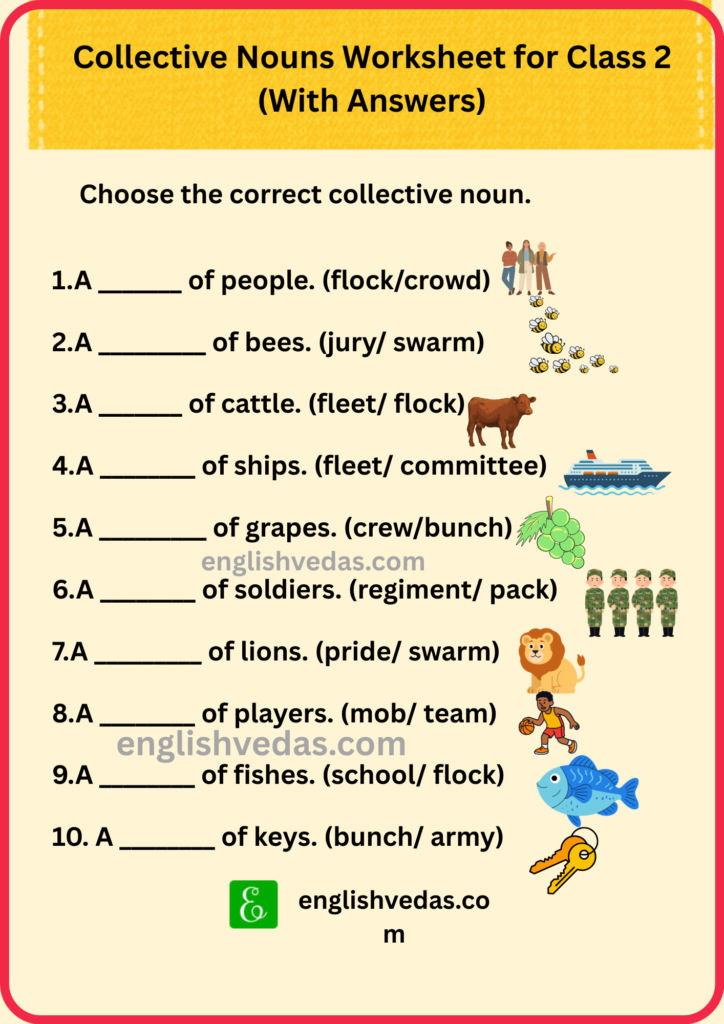
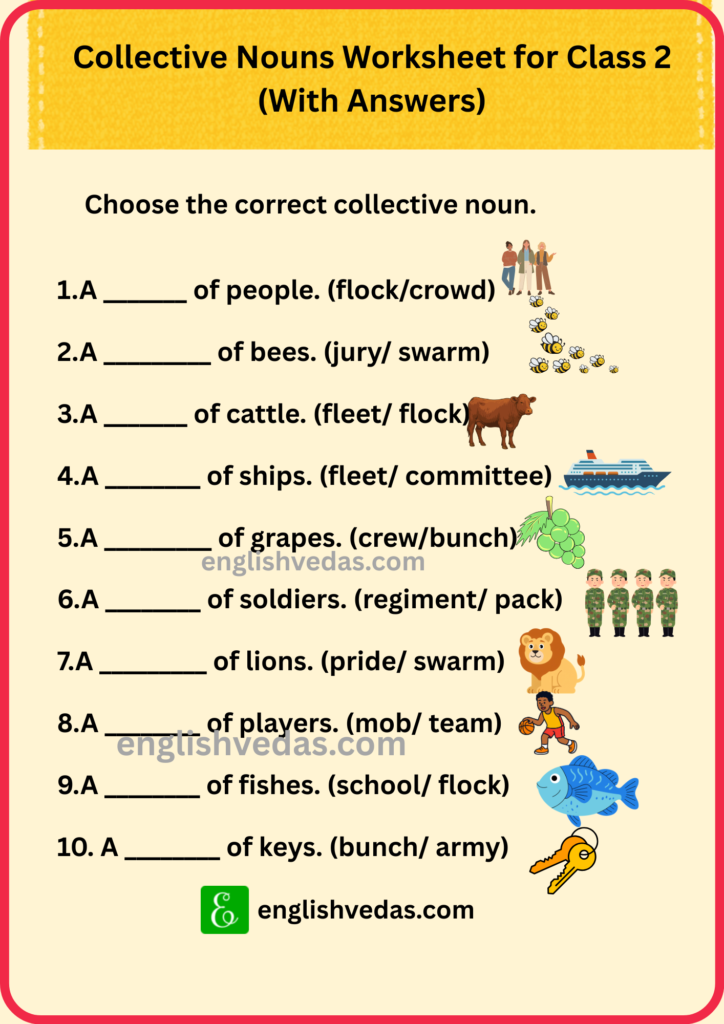
Choose the correct collective noun.
- A _______ of people. (flock/crowd)
- A _________ of bees. (jury/ swarm)
- A _______ of cattle. (fleet/ flock)
- A ________ of ships. (fleet/ committee)
- A _________ of grapes. (crew/bunch)
- A ________ of soldiers. (regiment/ pack)
- A _________ of lions. (pride/ swarm)
- A ________ of players. (mob/ team)
- A ________ of fishes. (school/ flock)
- A ________ of keys. (bunch/ army)
Exercise 2
Match the following.
| Column A | Column B |
| Panel | Singers |
| Forest | Stars |
| Range | Birds |
| Swarm | Judges |
| Flock | People |
| Choir | Mountains |
| Galaxy | Ships |
| Staff | trees |
| Fleet | Employees |
| Crowd | Bees |
Exercise 3 (Collective Nouns Worksheet for Class 2)
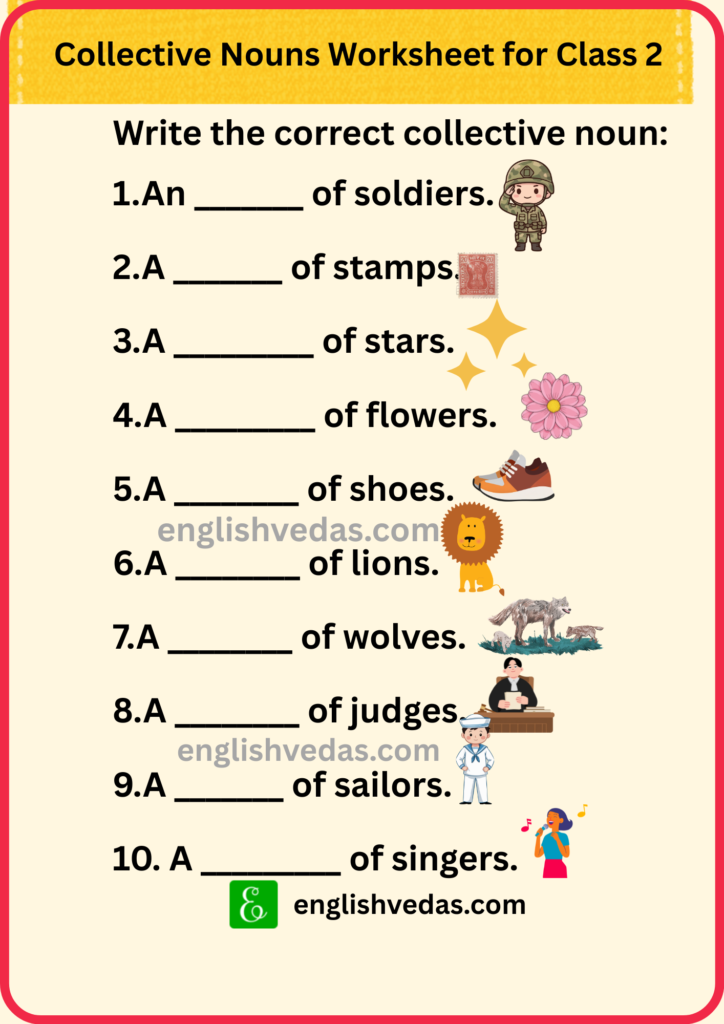
Write the correct collective noun:
- An _______ of soldiers.
- A _______ of stamps.
- A _________ of stars.
- A _________ of flowers.
- A ________ of shoes.
- A ________ of lions.
- A ________ of wolves.
- A ________ of judges.
- A _______ of sailors.
- A _________ of singers.
Exercise 4
Circle the correct answer:
- A group of people is called a:
(a) crowd (b) herd (c) pack - A group of soldiers are called a:
(a) team (b) army (c) bunch - A group of fish is called a:
(a) school (b) flock (c) pride - A group of singers is called a:
(a) crew (b) choir (c) swarm - A collection of flowers is called a:
(a) bunch (b) bouquet (c) pack - A group of students is called a:
(a) class (b) army (c) pride - A group of lions is called a:
(a) herd (b) pride (c) team - A collection of fruits is called a:
(a) basket (b) fleet (c) swarm - A group of sailors is called a:
(a) crew (b) choir (c) pack - A group of mountains is called a:
(a) forest (b) range (c) group
Answers:-
Exercise 1
- A crowd of people
- A swarm of bees
- A flock of cattle
- A fleet of ships
- A bunch of grapes
- A regiment of soldiers
- A pride of lions
- A team of players
- A school of fishes
- A bunch of keys
Exercise 2
- Panel → Judges
- Forest → Trees
- Range → Mountains
- Swarm → Bees
- Flock → Birds
- Choir → Singers
- Galaxy → Stars
- Staff → Employees
- Fleet → Ships
- Crowd → People
Exercise 3
- An army of soldiers
- A collection of stamps
- A galaxy of stars
- A bouquet of flowers
- A pair of shoes
- A pride of lions
- A pack of wolves
- A panel of judges
- A crew of sailors
- A choir of singers
Exercise 4
- (a) crowd
- (b) army
- (a) school
- (b) choir
- (b) bouquet
- (a) class
- (b) pride
- (a) basket
- (a) crew
- (b) range
Also Read:-
- Prepositions with Adjectives: 50 Easy Sentences and Examples
- Subject and Predicate Worksheet for Class 3 and Class 4 (With Answers + Free PDF Download)
- Can Artificial Intelligence Replace Human Intelligence?| Best Debate 2026
- Future Perfect Tense Worksheet with Answers (Free PDF Download)
- Comparison of Adjectives Worksheet with Answers
- Active and Passive Voice Worksheet for Class 6 (With Answers)

My name is Sukhjit Kaur, and I am an English educator with 17+ years of experience helping students master grammar and writing. Through EnglishVedas.com, I simplify English grammar using examples from daily life and classrooms. I’ve been analyzing English media for 17 years to help students understand how grammar lives in the real world.