
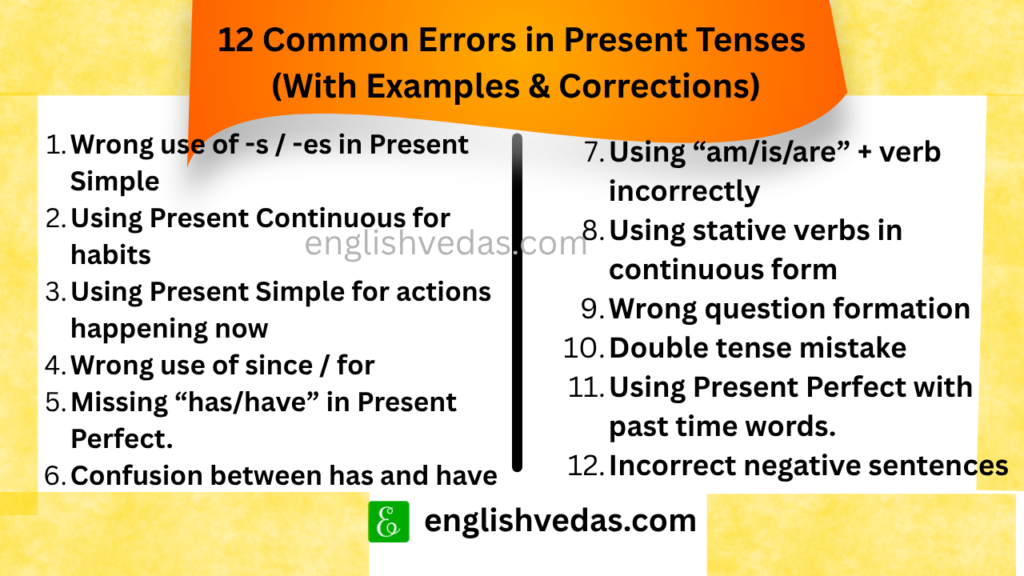
The lesson explains the 12 common errors in present tenses. The simple present tense is an essential component of English grammar. Although it is simple, learners often make mistakes when using this tense. Understanding the common errors or mistakes can help you improve your English speaking and writing skills to a large extent. Let’s understand these mistakes and learn how to avoid them or not repeat them.
1. Wrong use of -s / -es in Present Simple (Common Errors in Present Tenses).
One of the most frequent errors involve use of s or es in the present simple. In English grammar it is important that the verb must agree with the subject.
👉 Mistake: She do her homework.
✅ Correct: She does her homework.
Rule: Use -s/-es with he/she/it.
Notice how the verb “do” changes to “does” when the subject is third-person singular (he, she, it). Many students forget to add the “s” or “es” to the verb when the subject is third-person singular.
2. Using Present Continuous for habits
Always use the present simple tense for daily routine or habits.
👉 Mistake: I am having breakfast every day.
✅ Correct: I have breakfast every day.
Rule: Use Present Simple for daily routines.
Common mistakes include the use of the verb in continuous form for daily habits.
3. Using Present Simple for actions happening now.
Another common mistake is using the Simple Present tense incorrectly, which is using it for actions happening now.
👉 Mistake: I sing a song right now.
✅ Correct: I am singing a song right now.
Rule: Do not use the simple present tense for the actions happening at the present moment. Use Present Continuous for actions happening at the moment.
4. Wrong use of since / for
👉 Mistake: I am staying in his house since 5 years.
✅ Correct: I have been staying in this house for 5 years.
Rule:
- Since → starting point
- For → duration
- Use Present Perfect Continuous. Use for and since to say how long.
Note: The simple present tense should not be used to describe the actions that have started in the past and are still continuing.
5. Missing “has/have” in Present Perfect.
The present perfect is used for an action in the past with a result or outcome now. In it, we use has and have with the third form of the verb (past participle).
👉 Mistake: She cleaned her room. (when time not mentioned)
✅ Correct: She has cleaned her room.
Notice: In the first sentence, the time is not mentioned like yesterday, last night, etc. So, we need to use the present perfect tense “has cleaned”. If the subject was “I” instead of “She”. The sentence is, “I have cleaned my room.”
6. Confusion between has and have
👉 Mistake: She have eaten the apple.
✅ Correct: She has eaten the apple.
7. Using “am/is/are” + verb incorrectly (Common Errors in Present Tenses)
👉 Mistake: She is know that woman.
✅ Correct: She knows that woman.
Rule: Don’t mix simple and continuous forms.
Note: Helping verbs am, is, and are, are used for the continuous tense. Hence, “is” continuous while “know” is simple tense.
8. Using stative verbs in continuous form
👉 Mistake: I am believing what he said.
✅ Correct: I believe what he said.
Common stative verbs: know, like, love, believe, understand
9. Wrong question formation
This is a very common mistake among students. They forget to swap the helping verb with the subject. For instance, in the example below, “You are” changes to “Are you” to convert the sentence into question form. Another example is, “I am late” becomes “Am I late?” in interrogative form.
👉 Mistake: You are listening to music
✅ Correct: Are you listening to music?
10. Double tense mistake
Confusing the form of the verb to be used is another typical mistake. In the sentence below, “has break” is wrong. Instead, use “has broken”, the past participle form of the verb.
👉 Mistake: He has break the stick.
✅ Correct: He has broken the stick.
11. Using Present Perfect with past time words.
Time factor plays an important role in the use of tenses. Time expressions like yesterday, last Monday, last night, last week, etc. are not used in the present perfect tense.
👉 Mistake: I have watched a film yesterday.
✅ Correct: I watched a film yesterday.
12. Incorrect negative sentences
When we make negative sentences in the simple present tense, we use “do not” and “does not”. Sometimes learners forget to use do and does in negatives.
👉 Mistake: She not like oranges.
✅ Correct: She doesn’t like oranges.
Notice in the sentence above “doesn’t like” is used with third-person singular subjects, and “do not” with others.
So, these are the 12 common Errors in present tenses which are explained in a simple and easy manner.
People Also Ask:-
1. What are the most common mistakes in the present tenses?
Many students confuse present tenses by using the present continuous for habits, the present simple for actions happening now, misusing has and have, using stative verbs in the continuous form, and using the present perfect with past time expressions.
2. How can I avoid errors in present tense usage?
Students can avoid errors by practising tenses regularly, learning the use of words like often, always, just, and since in English grammar, and understanding the use of tenses in different situations and times.
3. Why is it important to learn correct present tense usage?
When we use tenses correctly our communication skills improve. We can write and speak English with ease and our confidence improves.
Also Read:-
- Best Real Life Scenario for Practising Tenses
- Present Perfect Continuous Tense Exercises for Class 6, 7, 8 (With Answers PDF)
- Simple Present Tense Worksheet
- Simple Past Tense Worksheet for Kids with Answers (Free PDF)
- 100 Simple Future Tense Example Sentences with Structure and Usage
- Can Artificial Intelligence Replace Human Intelligence?| Best Debate 2026
- Future Perfect Tense Worksheet with Answers (Free PDF Download)

My name is Sukhjit Kaur, and I am an English educator with 17+ years of experience helping students master grammar and writing. Through EnglishVedas.com, I simplify English grammar using examples from daily life and classrooms. I’ve been analyzing English media for 17 years to help students understand how grammar lives in the real world.