
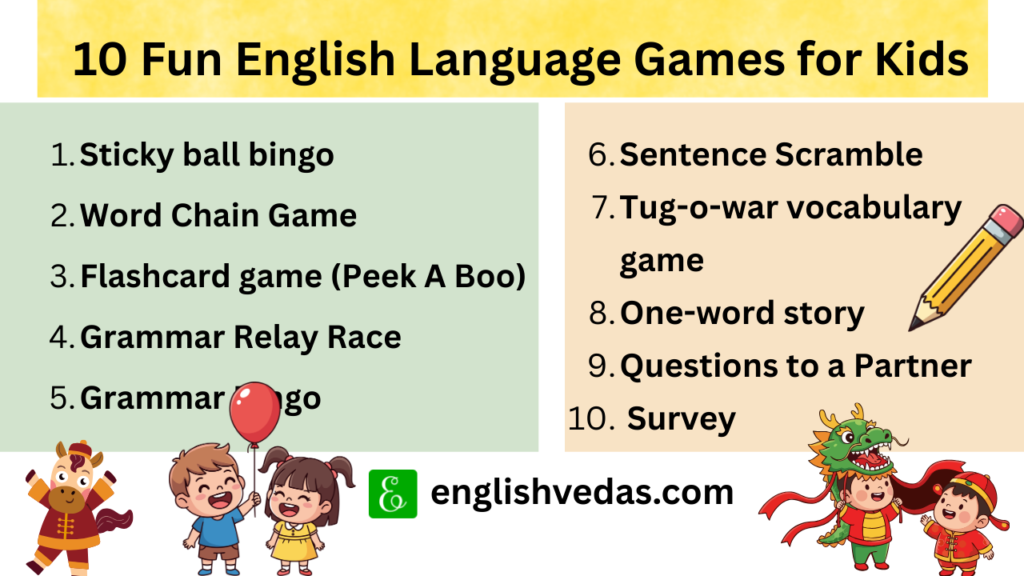
The 10 fun English language games help students use and practice grammar in an entertaining, engaging way. Grammar can be made enjoyable for students through games. The games are designed to get your students actively involved using target structures and excited about learning grammar. Often, students know English grammar, and they also know the rules, but they lack practice. It is important to get students practising what they have learnt. These are fun grammar games for the classroom. It also includes vocabulary games for students and games to improve speaking skills.
1. Sticky Ball Bingo
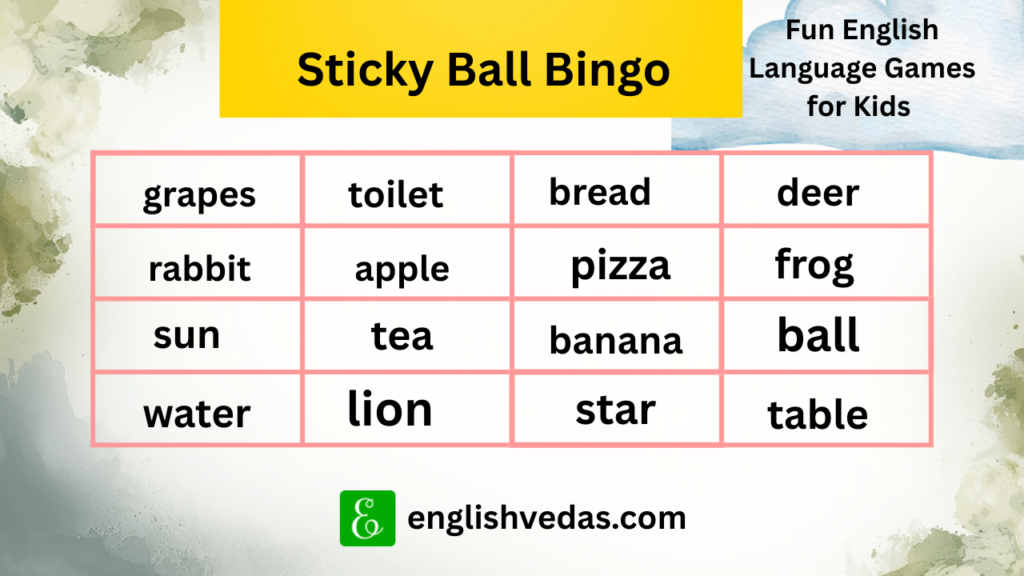
What you need: Whiteboard. Marker, sticky balls.
How to play: It has a 4 x 4 grid. If there are more students, you can have a 4 x 4 grid. In each grid, a word is written.
The teacher will elicit answers from the kids by asking them to describe the word.
The class can be divided into 2 teams: Team A and Team B.
The students are given sticky balls, and a line is drawn on the floor to separate the teams.
They will hit the word with the ball after they describe it, and then will be asked to make a sentence with it. Every line they complete they get a star.
Why it helps: Improves vocabulary and sentence formation.
2. Word Chain Game
What you need: Whiteboard, marker.
How to play: Students stand in two rows. They will say a word and pronounce the last letter of the word one by one. Once all the letters are uttered, they make a word out of those letters, and the team gets points according to the number of words formed.
Why it helps: Word formation and improves memory.
3. Flashcard game (Peek A Boo)
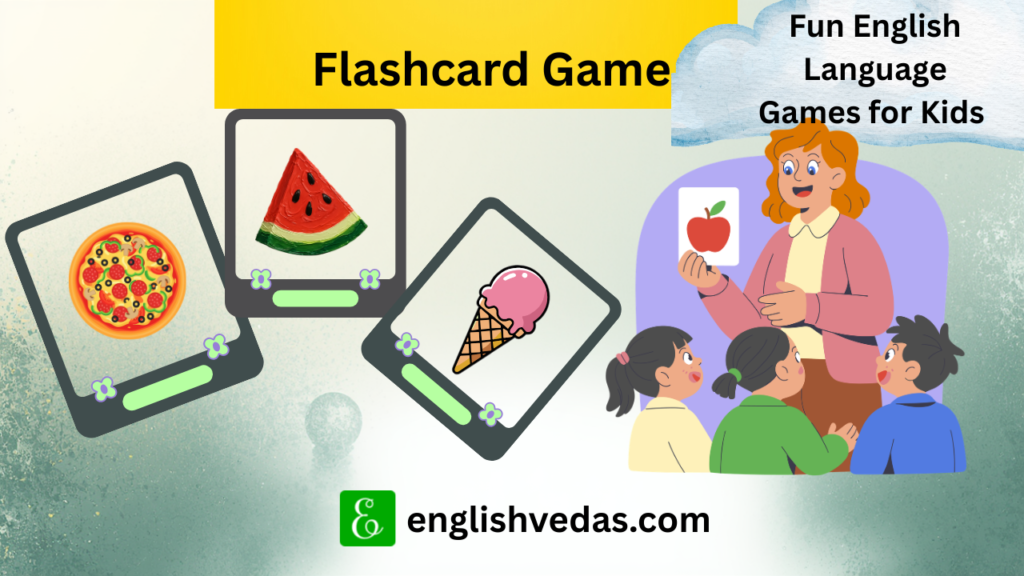
What you need: Flashcards
How to play:
- The mentor will have a set of flashcards which he will show to the kids. And ask, what do you want for the main dish, and show a card with a picture of pizza in it.
- Students will say I want pizza and take a step forward. What do you want for dessert? The kids will say ‘I want ice cream’ when they see picture of ice cream.
- The next question is, what do you want for vegetables? The kids will answer, ‘I want salad’ and come forward. Next question is what do you want to drink, the kids will answer, I want milk.
- The teacher will close her eyes, and once she opens her eyes, all the students will freeze. When the teacher says, ‘I am hungry’, and they come forward, the kids are supposed to run away.
- Have them stand in a line. Answer the questions and move forward slowly when the teacher covers his eyes, while freeze when he uncovers his eyes. To keep the game fun and smooth, define a simple rule that if, after I uncover my eyes if you are still moving, or you are not answering, or If you are moving faster, you will be out of the game. (Don’t let them sit by the way. ) And pay attention to the safety of the kids, if they are young.
Why it helps: Coordination and sentence formation improves.
4. Grammar Relay Race
What you need: Slips with grammar questions or sentence completion questions.
How to play: This game is perfect for getting students moving out of their seats. The class is divided into two teams. Prepare a set of grammar questions or sentences with blanks that need to be filled in. Place the questions at one end of the room and have students line up at the other end. One student from each team runs to the questions and answers one, and then runs back.
For example, if the question is, ‘Have you ever eaten an egg?’, the student will answer, “Yes, I have eaten an egg.”
The first team to correctly answer questions wins.
Why it helps: This exercise encourages teamwork and gives life to grammar practice.
5. Grammar Bingo
What you need: Bingo cards, whiteboard, marker.
How to play:
- Create bingo cards with target grammar structures or sentences with blanks to fill in. Then, call out the grammar questions or prompts. For example, ‘The boy is ________ down the street.’
- Students find the corresponding answers on the bingo cards and mark them.
- The different answers on the bingo card could be reading, writing, running, singing, etc.
- The first student to complete a row shouts “Bingo” and wins.
- Why it helps: This game is simple and a great way to hone English grammar.
- This game is a great way to reinforce and review both simple and complex grammar structures.
6. Sentence Scramble
What you need: scissors, paper, and a pen.
How to play:
- This activity challenges students to think critically about sentence structure.
- Write several sentences related to the grammar points the teacher is teaching, then cut them into individual words or phrases.
- Mix up the pieces and distribute them to the students. Students can either work individually or in groups to reassemble sentences correctly. The first student or group to rearrange them wins.
Why it helps: Improves sentence structure and word order.
7. Tug-o-war vocabulary game
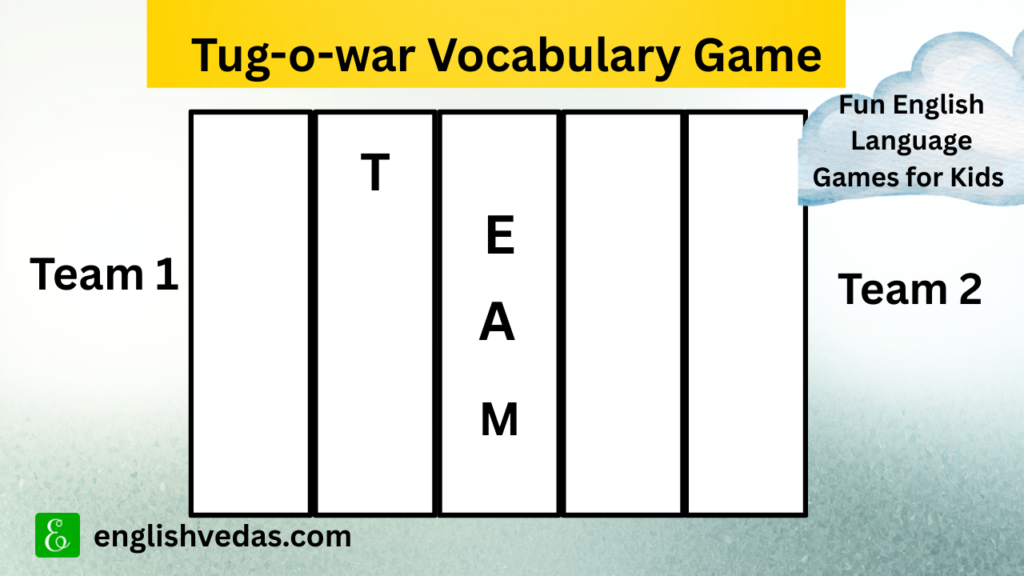
What you need: a whiteboard and a marker.
How to play: Split the class into two teams. On the board, draw six vertical lines. It’s the tug-of-war field. Pick a word with no repeating letters. For example, a basket or a team. Write the letters of the word straight down the middle. A student from a team picks one of the letters and says a word from it. The teacher can challenge them by asking them to use only nouns, verbs, or adjectives. If the word is correct, that letter moves one step closer to their side. Then it’s team 2’s turn. They can pick the same letter or choose a different one. Team can keep fighting by pulling the letters back and forth, until it finally reaches the safe zone on one side.
Why it helps: Improves vocabulary.
8. One-word story
How to play:
- The good part is that this game always ends in laughter. Half the students sit in a circle. Explain that each person will only say one word.
- Together, they will build a sentence or a story. Students can only say one word when its’ their turn.
- Words should connect to the story logically. Encourage creativity in kids.
- This game is a great way to end class with some laughter.
Why it helps: This game improves listening speaking, and creativity.
9. Questions to a Partner
What you need: a list of questions.
How to play: Make a list of questions for students A and B. They ask each other questions. This activity maximizes student time.
Why it helps: Enhances confidence and improves speaking skills.
10. Survey
How to play:Teachers gives students some questions and students walk around in the class and ask one question to each student. Students get a chance to speak to friends they haven’t haven’t spoken to.
Why it helps: Improves speaking skills and sentence formation.
Also Read:-
- Should Students Be Allowed to Use AI Tools for Assignments? | Pros and Cons | Debate
- Has and Have Worksheet | Simple (Free Printable with Answers
- How to Choose the Correct Tense for Class 5 and 4 (Easy Rules and Examples)
- List of 50 Vocabulary Words for Class 3 | Best Words with Meanings
- Difference between While and During |Worksheet with Answers

My name is Sukhjit Kaur, and I am an English educator with 17+ years of experience helping students master grammar and writing. Through EnglishVedas.com, I simplify English grammar using examples from daily life and classrooms. I’ve been analyzing English media for 17 years to help students understand how grammar lives in the real world.