
Quick Rule:
- During + noun/noun phrase: during the meeting, during the holiday, during the exam
- While + subject + verb: while I was studying, while she was sleeping
- For + length of time: for two hours, for three days
This article explains the difference between while and during. It contains a worksheet with answers. The worksheet exercise is simple and easy to solve. The difference between while and during is explained with the help to simple example sentences for better understanding. Students from CBSE and ICSE boards can use it. Students preparing for board and competitive exams can practice.
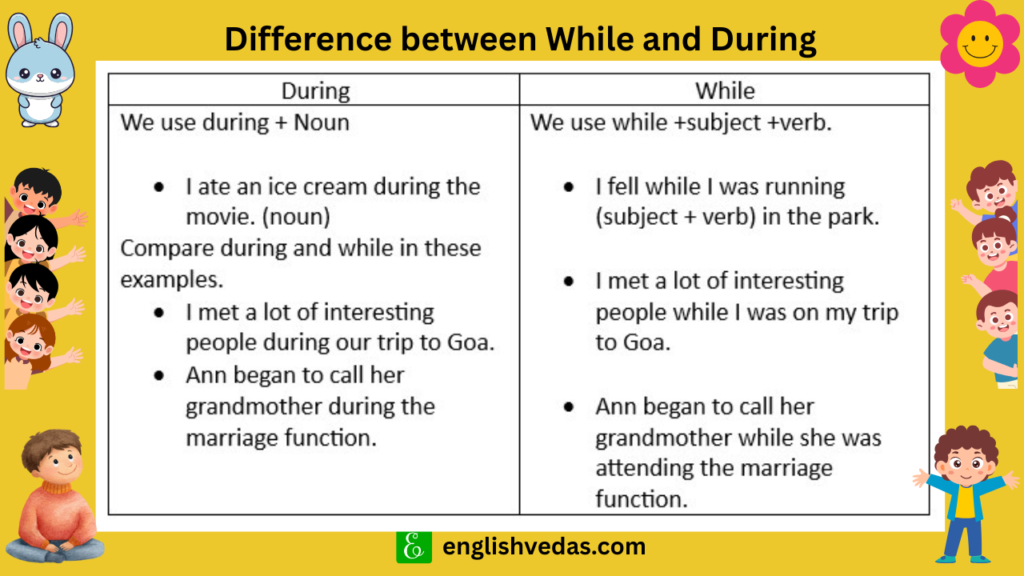
| During | While |
| We use during + Noun. | We use while +subject +verb. |
| I ate an ice cream during the movie. (noun) | I fell while I was running (subject + verb) in the park. |
| Compare during and while in these examples. | |
| I met a lot of interesting people during our trip to Goa. | I met a lot of interesting people while I was on my trip to Goa. |
| Ann began to call her grandmother during the marriage function. | Ann began to call her grandmother while she was attending the marriage function. |
Difference between During, While, and For. (Rules)
| Word | Grammar | Example |
| During | during + noun/noun phrase | We talked during the class. |
| While | While + subject + verb | We talked while the teacher was away. |
| For | For + length of time | We talked for two hours. |
During tells us when something happens. For tells us how long it happens.
During is used before a noun or noun phrase to show when something happens. It is one of the useful time-related prepositions in English. Learn more about Prepositions and their different uses.
To understand the difference between since and for and how they are used to express duration, see our guide to Since vs For.
While and during are both used to talk about time, but they are used differently in a sentence.
While vs During Examples
- I fell asleep during the class.
- I fell asleep while I was sitting in class. (The structure while + subject + verb is often used with the Past Continuous Tense to describe an action that was in progress when another event happened.
- We went to the museum during the winter.
- We went to the museum while we were travelling in the winter.
- She called me during dinner.
- She called me while I was eating dinner.
Choosing the correct tense often depends on understanding when an action happens and whether it is completed or continuing. For more practice, see our guide on How to Choose the Correct Tense for Class 5.
Example Sentences of While.
- I saw Tina while I was eating in a restaurant.
- Jack cleaned the room while I cut vegetables.
- I made a lot of friends while I was on holiday.
- He came home while I was cooking food.
- They went to the playground while I was playing the guitar.
- I fell asleep while I was watching television.
- He did his homework while he was sitting in the car.
- He took a shower while I was packing his suitcase.
- You can wait here while I return the book to the librarian.
- I met Sue while I was shopping.
Common Mistakes with While and During
❌ During I was reading, my friend called me.
✅ While I was reading, my friend called me. (In sentences such as “While I was reading, my friend called me,” while connects two clauses and works as a conjunction. Learn more about how conjunctions connect words and clauses in our guide to Conjunctions.
❌ While the interview, interviewees remained quiet.
✅ During the interview, interviewees remained quiet.
❌ During I was studying, my brother helped me.
✅ While I was studying, my brother helped me.
Example Sentences of During.
- We didn’t speak during the class.
- He didn’t write an essay during his break.
- He did a lot of shopping during his holidays.
- Diane called his mother during the film.
- I played tennis during the sports period.
- We became tired during our visit to Delhi.
- I drank water during my interview.
- She sat beside me during the music concert.
- Maria read a magazine during the journey.
- She talked to a stranger during her trip.
Exercise
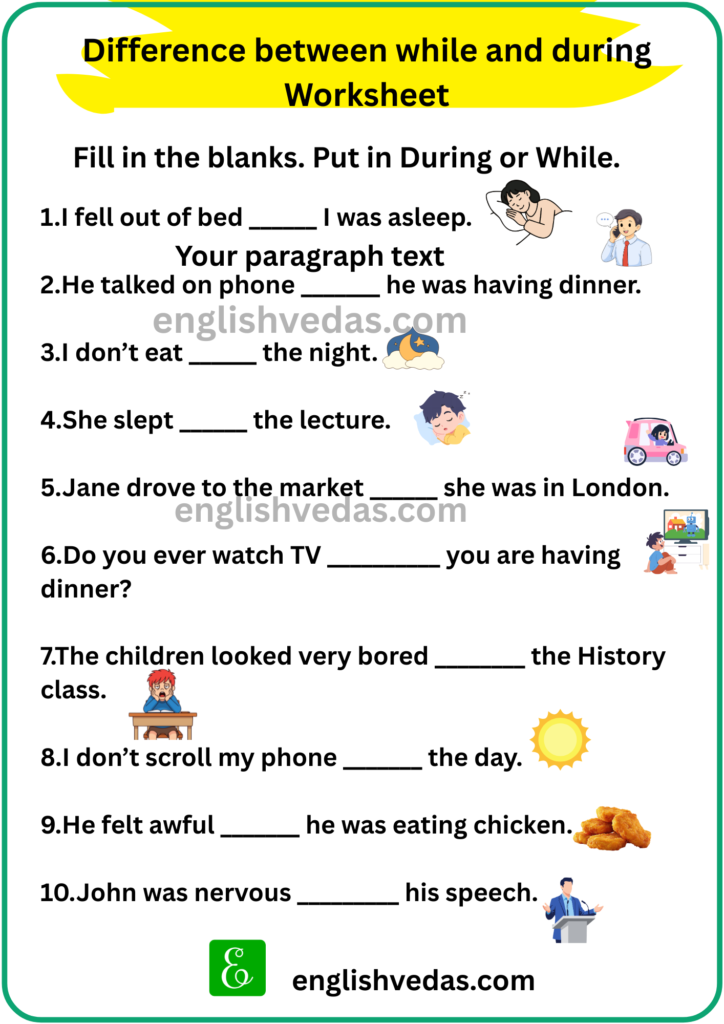
Fill in the blanks. Put in During or While.
- I fell out of bed ______ I was asleep.
- He talked on phone _______ he was having dinner.
- I don’t eat ______ the night.
- She slept ______ the lecture.
- Jane drove to the market ______ she was in London.
- Do you ever watch TV __________ you are having dinner?
- The children looked very bored ________ the History class.
- I don’t scroll my phone _______ the day.
- He felt awful _______ he was eating chicken.
- John was nervous _________ his speech.
Answers
- I fell out of bed while I was asleep.
- He talked on phone while he was having dinner.
- I don’t eat during the night.
- She slept during the lecture.
- Jane drove to the market while she was in London.
- Do you ever watch TV while you are having dinner?
- The children looked very bored during the History class.
- I don’t scroll my phone during the day.
- He felt awful while he was eating chicken.
- John was nervous during his speech.
People Also Ask:-
1. What is the main difference between while and during?
While is used to show two actions happening at the same time, and it has a subject and a verb. During is used before a noun to show when something happens.
Example: While I was cycling, she phoned me.
During the film, she messaged me.
2. Can while and during be used interchangeably?
No, while and during cannot be used interchangeably. We use during plus noun (during the movie). We use while plus verb (while I am listening to music).
Also Read:-
- Will Artificial Intelligence Create More Jobs or Take Away Jobs in the Future?|Debate
- Should Mobile Phones Be Allowed in School Essay
- Adjective Clause for Class 8–9 | Examples and Exercises
- Countable and Uncountable Nouns Worksheet with Answers
- Noun Clause Examples with Answers | Simple Exercises
- Adverb Clauses Explained |Best Examples | 1 Exercise with Answers
- Conjunctions Exercise for Class 7 with Examples and Answers

My name is Sukhjit Kaur, and I am an English educator with 17+ years of experience helping students master grammar and writing. Through EnglishVedas.com, I simplify English grammar using examples from daily life and classrooms. I’ve been analyzing English media for 17 years to help students understand how grammar lives in the real world.