
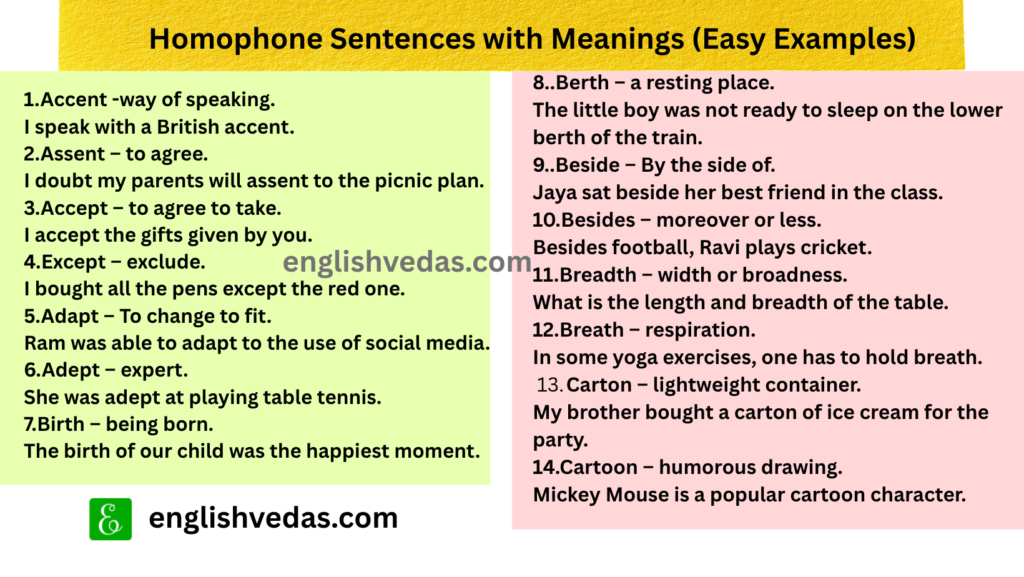
This lesson contains 50 homophone sentences with meaning and examples. Homophone sentences improve the writing and speaking of the learners. It also contains an exercise worksheet with answers on homophone sentences.
What are homophones?
Homophones are words that sound the same but have different meanings and spellings. They can be confusing, but learning them with sentences makes understanding easy and fun.
50 Homophone Sentences
- Accent -way of speaking.
I speak with a British accent.
- Assent – to agree.
I doubt my parents will assent to the picnic plan.
- Accept – to agree to take.
I accept the gifts given by you.
- Except – exclude.
I bought all the pens except the red one.
- Adapt – To change to fit.
Ram was able to adapt to the use of social media.
- Adept – expert.
She was adept at playing table tennis.
- Birth – being born.
The birth of our child was the happiest moment.
- Berth – a resting place.
The little boy was not ready to sleep on the lower berth of the train.
- Beside – By the side of.
Jaya sat beside her best friend in the class.
- Besides – moreover or less.
Besides football, Ravi plays cricket.
- Breadth – width or broadness.
What is the length and breadth of the table.
- Breath – respiration.
In some yoga exercises, one has to hold breath.
- Carton – lightweight container.
My brother bought a carton of ice cream for the party.
- Cartoon – humorous drawing.
Mickey Mouse is a popular cartoon character.
- Cell- small room.
The criminal had to spend five years in a cell.
- Sell – offer for sale.
Jack was ready to sell his guitar for money.
- Sight – vision.
It is said that out of sight is out of mind.
- Site-exact location.
The construction site had lots of labourers.
- Click – make a light and sharp sound.
He had to click on the mouse button to order food online.
- Clique- small group of people.
Tom was invited to join their clique.
- Conscience – inner sense of right and wrong.
His conscience did not allow him to lie.
- Conscious – aware or awake.
He was conscious for an hour, and then he went into a coma.
- Decent – adequate.
Sita belongs to a decent family.
- Descent – going downward.
His descent from the airplane was slower after he pulled the cord on his parachute.
- Root – origin or source.
I need to get to the root cause of the problem.
- Root – Underground part of a plant.
A potato is a root vegetable.
- Especially – standing apart uniquely from the rest.
Amritsar is famous for food, especially crispy Amritsari Kulcha.
- Specially – in particular.
I bought this doll, specially for my friend.
- Facility – something made to serve a function.
Empty the facility as soon as possible.
- Felicity – great happiness.
The trip to the hill station was a time of felicity for me.
- Fair – exhibition.
We bought these mats from the fair.
- Fare – cost of ride in a vehicle.
David could not afford the dare of an aeroplane.
- Heal- restore to health.
His wounds will heal in a few days.
- Heel – part of a shoe or part of a foot.
She cannot walk fast because of a blister on her heel.
- Human – of mankind.
Creativity is a human nature.
- Humane – kind and good.
It is not humane to keep birds in cages.
- Ingenious – clever and imaginative.
Raghu made an ingenious guide to help the students.
- Ingenuous – innocent and simple.
His ingenuous nature earned him fame.
- Lessen – decrease.
The ointment did not lessen her pain.
- Lesson – unit of instruction.
The incident was a life lesson for the students.
- Loose – not tight.
The boy left the lid of the jar loose.
- Lose – misplace.
The football team was scared to lose the match.
- Peace – absence of war.
The countrymen wanted peace after the war.
- Piece – a part of a whole.
The girl wanted to eat a piece of cake.
- Peal – loud sound.
The peal of the doorbell woke him up.
- Peel – outer covering of a fruit.
I threw the orange peel in the dustbin.
- Some – any part of.
I would like to taste some of your cookies.
- Sum – the total of.
The sum of two and three is five.
- Tail – last part.
The dog was wagging its tail.
- Tale – story.
The tale of that city is interesting.
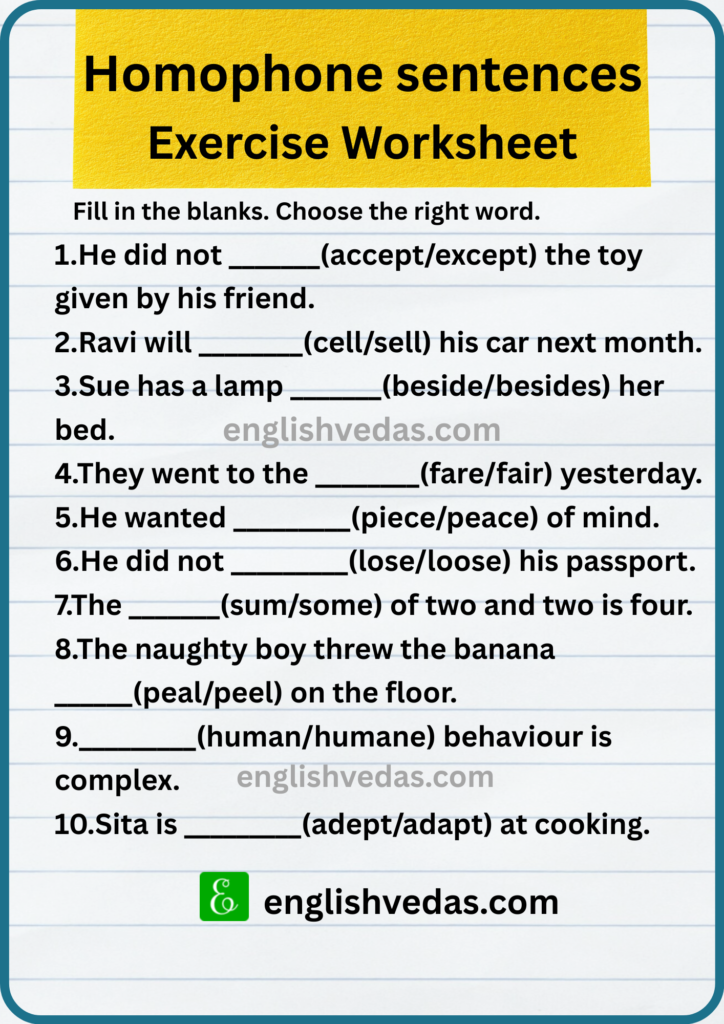
Practice Exercise
Fill in the blanks. Choose the right word.
- He did not _______(accept/except) the toy given by his friend.
- Ravi will ________(cell/sell) his car next month.
- Sue has a lamp _______(beside/besides) her bed.
- They went to the ________(fare/fair) yesterday.
- He wanted _________(piece/peace) of mind.
- He did not _________(lose/loose) his passport.
- The _______(sum/some) of two and two is four.
- The naughty boy threw the banana ______(peal/peel) on the floor.
- _________(human/humane) behaviour is complex.
- Sita is _________(adept/adapt) at cooking.
Answer Key
1. He did not accept the toy given by his friend.
2. Ravi will sell his car next month.
3. Sue has a lamp beside her bed.
4. They went to the fair yesterday.
5. He wanted peace of mind.
6. He did not lose his passport.
7. The sum of two and two is four.
8. The naughty boy threw the banana peel on the floor.
9. Human behaviour is complex.
10. Sita is adept at cooking.
Also Read:-
- 12 Common Errors in Present Tenses (With Examples and Corrections)
- Best Real Life Scenario for Practising Tenses
- Present Perfect Continuous Tense Exercises for Class 6, 7, 8 (With Answers PDF)
- Past Perfect Tense Worksheet Pdf
- Preposition Worksheet for Class 5 with Answers (Free Printable PDF)

My name is Sukhjit Kaur, and I am an English educator with 17+ years of experience helping students master grammar and writing. Through EnglishVedas.com, I simplify English grammar using examples from daily life and classrooms. I’ve been analyzing English media for 17 years to help students understand how grammar lives in the real world.