
By 2026, You’ll Have Been Making These Grammar Mistakes Forever – Master Future Perfect Continuous Tense Example Sentences Now
This article explains what the Future Perfect Continuous Tense is, its structure, when we use it, and provides example sentences. It helps students to use the future perfect continuous tense in English Grammar. They are explained with examples that are simple and easy to understand for beginners. The time expressions used in the Future Perfect Continuous Tense are explained clearly.
The lesson is exam-oriented and is helpful for CBSE and ICSE students as well as those preparing for board and competitive exams. It will help the students to improve and speak correct English.
What Is the Future Perfect Continuous Tense?
When an action is in progress, now can be considered from a point in the future. It is called the future perfect continuous tense.
What are Time Expressions used in the Future Perfect Continuous Tense?
- or + time period (for 3 years, for 5 hours, for a long time)
- since + point in time (since Tuesday, since 2018, since morning)
- by + future time (by tomorrow, by next week, by 7 PM)
What Is the Structure of the Future Perfect Continuous Tense?
Subject + Have been + Verb-ing +for/since +by (Object Time)
Affirmative (Positive) Sentence
Subject + will have been + verb(+ing) + object/time
Example:
- She will have been taking classes here for five years by next month.
- They will have been studying for 2 hours by the time their parents arrive.
2. Negative Sentence
Subject + will not (won’t) have been + verb(+ing) + object/time
Example:
- He will not have been staying in an apartment for long by next year.
- She won’t have been writing for more than 10 minutes.
3. Interrogative (Question) Sentence
Will + subject + have been + verb(+ing) + object/time?
Example:
- Will they have been dancing for 2 hours by 8 pm?
- Will he have been working here for two years by January?
4. Negative Interrogative
Will + subject + not + have been + verb(+ing)…?
or
Won’t + subject + have been + verb(+ing)…?
Example:
- Will you not have been playing with dolls for long?
- Won’t she have been teaching the girls for hours?
Future Perfect Continuous Tense Example Sentences
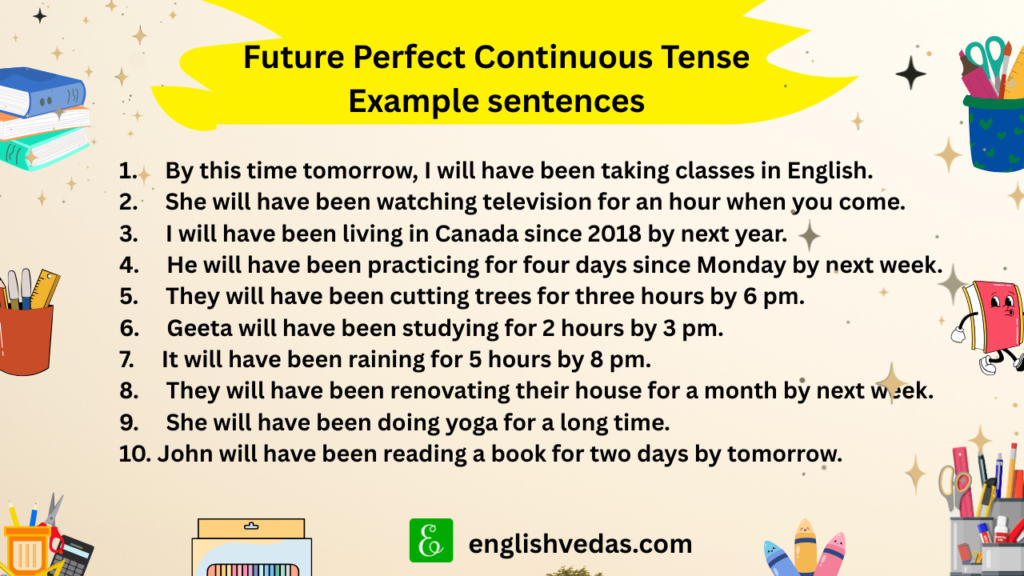
- By this time tomorrow, I will have been taking classes in English.
- She will have been watching television for an hour when you come.
- I will have been living in Canada since 2018 by next year.
- He will have been practicing for four days since Monday by next week.
- They will have been cutting trees for three hours by 6 pm.
- Geeta will have been studying for 2 hours by 3 pm.
- It will have been raining for 5 hours by 8 pm.
- They will have been renovating their house for a month by next week.
- She will have been doing yoga for a long time.
- John will have been reading a book for two days by tomorrow.
- Fiona will have been waiting for half an hour until the class ends.
- Tina will have been ironing clothes for thirty minutes when Mandy comes.
- The gardener will have been watering the plants for ten minutes since 9 am.
- Jack will have been doing homework for half an hour when his father comes.
- By this time tomorrow, I will have been going to the market.
- James will have been baking a cake by this time tomorrow.
- Diane will have been working in a bank by this time next year.
- We will have been sleeping by 9 pm.
- He will have been exercising for two hours by 8 am.
- She will have been driving her car for five hours by 10 pm.
- They will have been reading for one hour by 3.00 pm.
- He will not have been listening to music by 8.00pm.
- Will she have been practicing Maths problems by this time tomorrow?
- Will Richa not have been playing with dolls for long?
- Tom will have been cutting grass for two hours by 9:00 am.
- Arthur will have been riding his bike for two days by tomorrow.
- Our neighbours will have been travelling for two weeks by next Monday.
- She will not have been sweeping the floor for one hours.
- Will he not have been drawing in his drawing book by 7.00pm.
- He will have been giving food to the poor by this time tomorrow.
Also Read:-
- Use of as If in English Grammar with 20 Example Sentences
- Master Too and Enough: The 5-Minute English Grammar Exercise That Will Transform Your Speaking Forever
- Prefer and Would Rather Made Easy
- It and There Difference and Use in English Grammar Best
- Quite and Rather Difference With 30 Example Sentences
- 30 Had Better Sentences Examples
- Articles Worksheet for Class 2 in English Grammar | Pack of 3 Best Grammar Exercises
- Noun Clause Examples with Answers | Simple Exercises
- Adverb Clauses Explained |Best Examples | 1 Exercise with Answers

Written by Sukhjit Kaur, English educator with 17+ years of experience helping students master grammar and writing. Through EnglishVedas.com, she simplifies English grammar using examples from daily life and classrooms.