Education

Uses of Used to

Uses of Used to Exercises, Examples, Sentences in English Grammar

We use ‘used to’ with pronouns I, we, you, they, he, she, and it. The verb is used in the simple present form, like play, read, work, sit, etc. The negative is ‘I didn’t use to….’ The question is ‘Did you use to….?’ Uses of Used to Exercises with Examples People Also Ask:- Read More:- […]

Uses of Used to Exercises, Examples, Sentences in English Grammar Read More »

Active and Passive Voice

Active and Passive Voice: Worksheet with 100 Examples, Answers, Differences, and Rules Revealed!

In this article, you will understand how to solve 100 active passive voice sentences in the exercise with answers. This active-passive voice worksheet will help students understand the difference between active and passive voice, along with examples. What is Active and Passive Voice? The form of the verb shows that the person referred to by

Active and Passive Voice: Worksheet with 100 Examples, Answers, Differences, and Rules Revealed! Read More »

Points for and Against National Education Policy 2025

National Education Policy 2025: The Great Debate—Points For and Against

This blog will explain points in favor of and against the National Education Policy 2025. It is an in-depth analysis of the debate topic, which has affected every individual in the learning journey. Points in Favour of NEP 2025 It aims to educate the students academically, emotionally, and physically. It emphasizes nurturing the whole person,

National Education Policy 2025: The Great Debate—Points For and Against Read More »

There is or there are (plural)

‘There Is or There Are’ 100 Sentences Worksheet Examples to Boost Your Grammar Skills!

This blog is on ‘There Is or There Are’ 80 Sentences with Worksheet. It contains 100 example sentences as examples to boost your grammar skills. When we refer to a singular noun or an uncountable noun, we use ‘there is’. ‘There are’ is used for plural nouns. ‘Is’ is singular, whereas ‘are’ is plural. For

‘There Is or There Are’ 100 Sentences Worksheet Examples to Boost Your Grammar Skills! Read More »

Use of does (present simple negative)

Use of Do, Does, and Did Class 3 (Rules + 100 Examples +Worksheet)

In this article, you will learn the use of do does and did, including simple rules, examples, worksheets, and exercises with answers for class 3. It contains 100 example sentences. These are the basic rules for does, do, and did for beginners. Quick Rules – Did and Does• Does is used with he, she, it

Use of Do, Does, and Did Class 3 (Rules + 100 Examples +Worksheet) Read More »

Is Am Are for Class 2 Examples

Is Am Are Worksheet for Class 2 and Class 1: 100 Sentences English Grammar

This article is about is, am, are worksheet for class 2 and class 1 in English Grammar. This guide explains is, am, and are with simple examples for students and beginners. It includes a 100-sentence worksheet with is, am, and are. The sentences are simple for the students to understand. These are the basic rules

Is Am Are Worksheet for Class 2 and Class 1: 100 Sentences English Grammar Read More »

Will shall use

Mastering ‘Will’ vs. ‘Shall’ : Difference, Use, Rules, and Mind-Blowing Examples

Will and shall are the most common words used in the English language. This article will explain the use of will and shall and the difference between them. It has some simple and easy examples that will help the students learn the use of will and shall. When to Use Will and Shall? Rules for

Mastering ‘Will’ vs. ‘Shall’ : Difference, Use, Rules, and Mind-Blowing Examples Read More »

Difference between some and any

‘Some’ and ‘Any’ in English Grammar: 5 Surprising Differences

In this article, we have explained the differences between some and any. We have explained how some and any can be used in different way. In the end there is an exercise for the students to solve. Some refer to a limited but unspecified amount. It reflects the expectation of something available. Any refers to

‘Some’ and ‘Any’ in English Grammar: 5 Surprising Differences Read More »

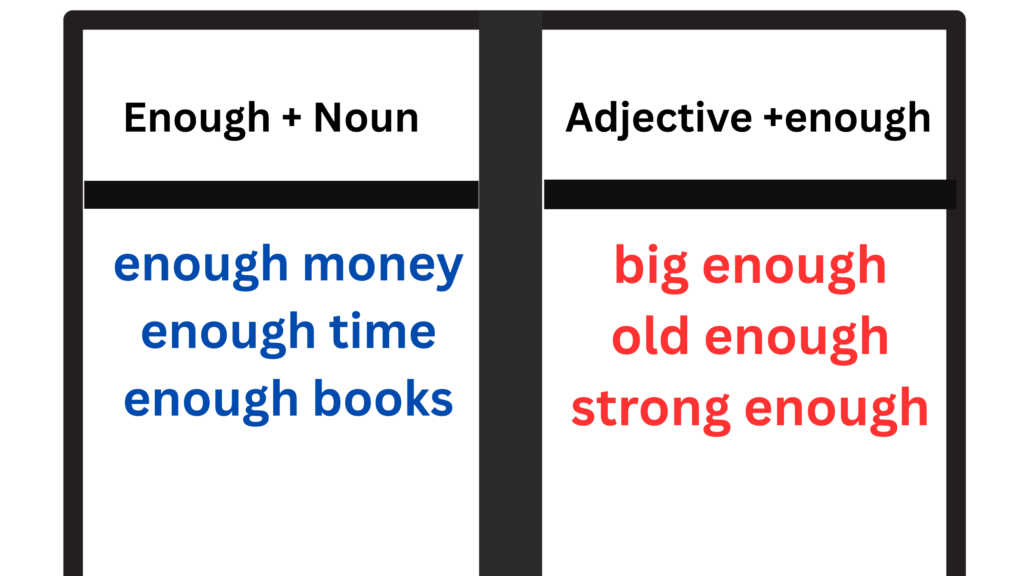
Use of enough with noun and adjective

Use of Enough in Grammar with 70 Example Sentences: Simple and Easy

How to Use of Enough in English Grammar? In this article, we will understand how to make sentences with enough in English grammar. It consists of 70 example sentences. Enough means sufficient or required. It also means as much or as many as required. How to Use Enough with a Noun (Example Sentences)? In the

Use of Enough in Grammar with 70 Example Sentences: Simple and Easy Read More »

Scroll to Top