
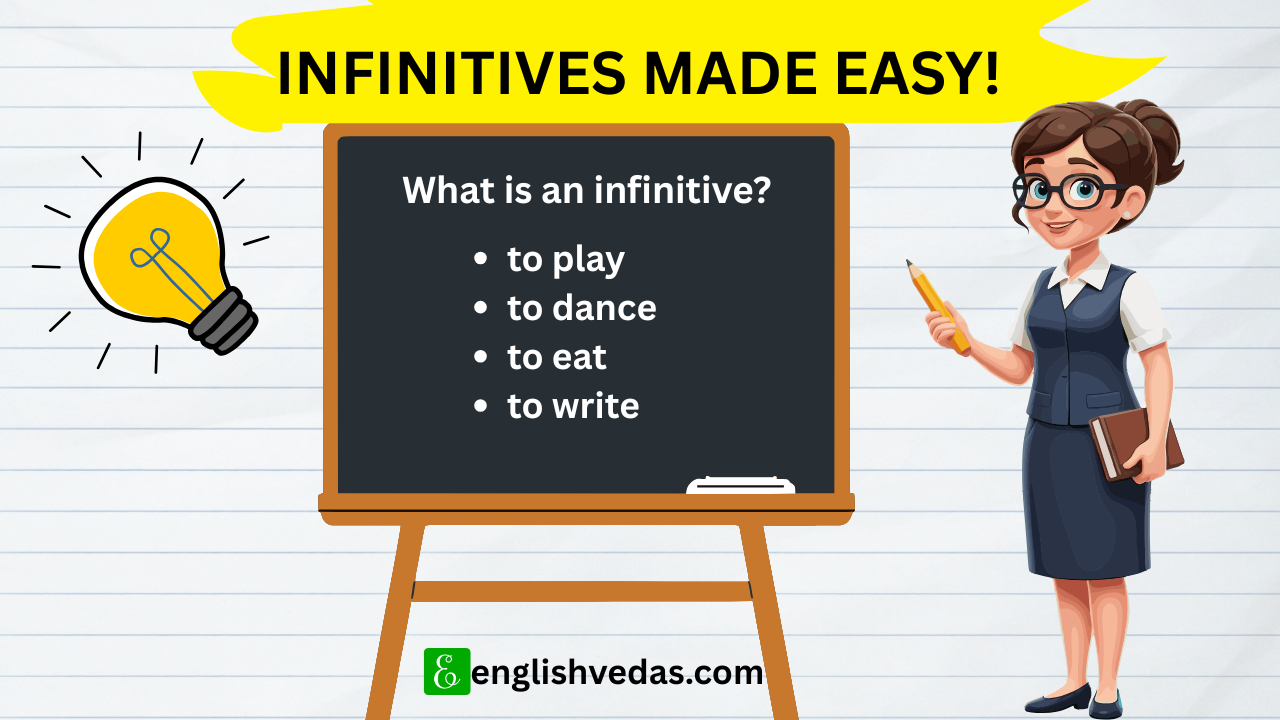

In this article, we will understand the use of infinitives with to or without to in English grammar. You will also find practice exercises with answers for better understanding. Infinitives is explained in a simple and easy way with clear examples. The lesson is helpful for CBSE and ICSE students. It is also helpful for students of board and competitive exams. There is a practice exercise for better understanding.
The infinitives are used with or without to:
- I want to dance.
- I am able to speak French.
- I can dance.
- I could sing.
The infinitives are used with to in the first two sentences. There are called to-infinitives.
The infinitive may be used:
- As the subject of a verb as,
- To err is human; to forgive is divine.
- To read is good for the mind.
- To run on snow can be dangerous.
- As the object of a verb as,
- Girls love to play with dolls.
- Boys like to play football.
- Soldiers do not fear to die.
- As an adjective as (noun + infinitive)
- He is the best man to ask for help.
- Clean water to drink is scarce in this city.
- Morning is the time to go to school.
- As the complement of a verb.
1) Sita appears to write well.
2) He seems to be kind.
3) Their greatest desire is to buy a car
As an adverb
- verb + infinitive
- We study to pass the exam.
- I came to buy a magazine.
- They practiced to win the match.
- adjective + infinitive
- I am glad to help you.
- They speak English.
- John is eager to learn swimming.
- adverb +infinitive
- Alice went there to learn to drive.
- We stayed at home to rest.
- Jack drew nicely to win the drawing competition.
As the object of a preposition.
1) He had no option but to sell his guitar.
2) He was about to reach the finishing line.
3) They were about to complete the project.
In passive form as,
1) Porus wanted to be treated as a kind.
2) to have been awarded a prize was a great honour.
3) The boss likes to be respected by his subordinates
Exercise on Infinitives.
Rewrite the following sentences using the introductory word it.
The first one is done for you.
- To eat this dish is difficult.
It is difficult to eat this dish.
- Rajeev was intelligent to pass the exam.
- To win the match was a great achievement.
- To sit on the wet grass was uneasy.
- John was silly to spend so much.
- To walk barefoot is not easy.
- To write a book in a day is difficult.
- To get good marks is the desire of the students.
- To walk on the left is quite safe.
- To eat with a spoon is convenient.
Answers
- It is difficult to eat this dish.
- It was intelligent of Rajeev to pass the exam.
- It was a great achievement to win the match.
- It was uneasy to sit on the wet grass.
- It was silly of John to spend so much.
- It is not easy to walk barefoot.
- It is difficult to write a book in a day.
- It is the desire of the students to get good marks.
- It is quite safe to walk on the left.
- It is convenient to eat with a spoon.
Infinitives ‘Without to’
- We do not use to in the infinitive with the following verbs:
Know, let, make, watch, hear, see, make, let.
- They let me sit there.
- They made him read fast.
- He saw her paint the wall.
- She need not read these books.
- He heard him speak French.
- We can also leave ‘to’ after ‘had better’, ‘sooner than’, ‘had rather’, ‘would rather’.
- She had better not eat too much sugar.
- Jane would rather work in a bank than in a hospital.
- Harry would rather read a book than watch a film.
Overall, the infinitive in English grammar helps students to write and speak in English effectively.
Also Read:-
- Complex Sentence Examples for Easy Grammar Learning
- Determiners Worksheet with Answers PDF | Easy Exercises | Free Download
- Uses of Modals for Class 5 | May, Might, Can, Could, Should & More with Examples
- Use of This, That, These, Those – 30 Example Sentences Worksheet for Class 1 (With Answers)
- Debate on Can AI Replace Teachers?|5 Points For and Against
- Debate: Are Friends Better Than Family in Today’s Modern Life?| Points For and Against 2025
- How to Use Causative Verbs in English Grammar (Have, Make, Get, Let) with Easy Examples
- Should Mobile Phones Be Allowed in School Essay

My name is Sukhjit Kaur, and I am an English educator with 17+ years of experience helping students master grammar and writing. Through EnglishVedas.com, I simplify English grammar using examples from daily life and classrooms. I’ve been analyzing English media for 17 years to help students understand how grammar lives in the real world.