
Complex Sentence Explained with Simple and Clear Examples
A complex sentence is a sentence that is formed by joining two simple sentences together. The clauses in a complex sentence are not of equal importance.
In the complex sentence, there is one independent clause and one dependent clause. The independent clause is the main clause, and the dependent clause is known as the subordinate clause.
When the bell rang, (subordinate clause) we came out of the class.( Main clause)
I do not know (main clause) if he is at home. (subordinate clause)
The subject of the main clause is replaced by a pronoun in a subordinate clause if a reference is made to it.
A pronoun can be used in a subordinate clause before the subject is mentioned. This is not possible with co-ordinate clause’s.
Noun Clauses
A noun clause is a group of words which contains a Subject and a Predicate of its own, and does the work of a noun.
She told me that the class has been cancelled.
He told me what? – “That the class has been cancelled.”
Therefore, it is a noun clause. It has a subject and a predicate.
A noun clause can be:
- The subject of a verb:
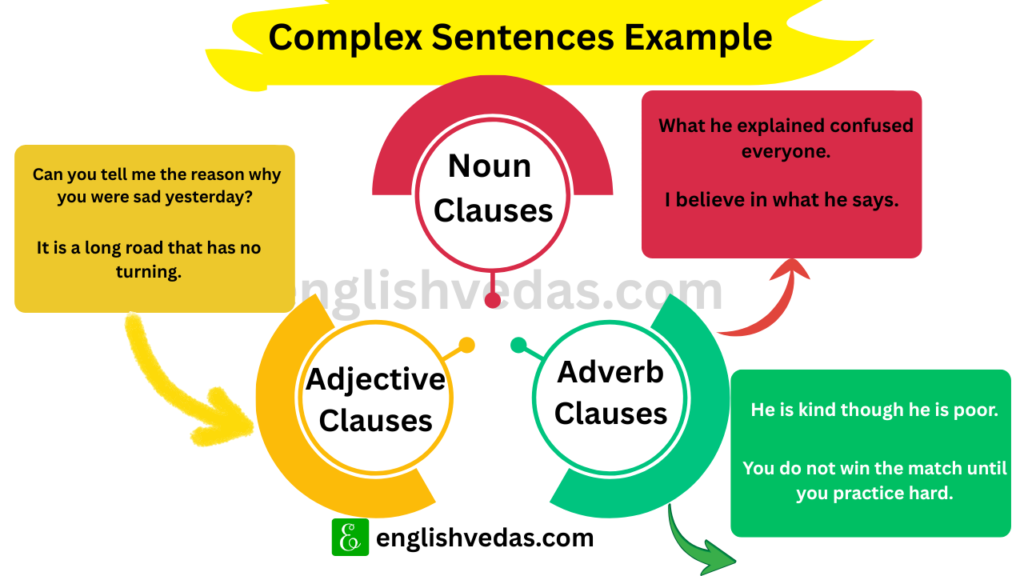
What he explained confused everyone.
- The object of a verb:
Everyone knows that honesty is the best policy.
- The object of a preposition.
I believe in what he says.
Except that she is talkative she is a good student.
- The complement to a verb.
This was how he won the first prize.
He believes that she will pass the exam.
- In apposition to a noun or pronoun:
It is worrisome that she has stopped taking vitamins.
The idea that we should buy more books was good.
Adjective Clauses
It refers to making a complex sentence from a simple sentence by introducing an adjective clause by using who, whom, whose or which, and the Relative Adverb where or why.
- The dress was expensive. I bought it.
I bought the dress which was very expensive.
- I met my cousin. He is now a doctor.
I met my cousin who is now a doctor.
- You looked sad yesterday. Can you tell me the reason?
Can you tell me the reason why you were sad
yesterday?
- It is a long road. It has no turning.
It is a long road that has no turning.
Adverb Clauses
When we join two or more sentences using subordinate conjunctions like, if, since, because, while, though, until, as, unless, when before, that we make a complex sentence by the use of an adverb clause.
- He is helpful. He is rich.
He is helpful, though he is rich.
- I did it. I wanted to.
I did it because I wanted to.
- I am happy. You like it.
I am happy that you like it.
- You will pass. Study hard.
You will pass if you study hard.
- You are going now. Bring me some water.
Before you go, bring me some water.
- Tina is more intelligent. Diane is less intelligent.
Tina is more intelligent than Diane is.
- The problem is very simple. Even a child can solve it.
The problem is so simple that even a child can solve it.
Also Read:-
- Determiners Worksheet with Answers PDF | Easy Exercises | Free Download
- Uses of Modals for Class 5 | May, Might, Can, Could, Should & More with Examples
- Use of This, That, These, Those – 30 Example Sentences Worksheet for Class 1 (With Answers)
- Debate on Can AI Replace Teachers?|5 Points For and Against
- Debate: Are Friends Better Than Family in Today’s Modern Life?| Points For and Against 2025
- How to Use Causative Verbs in English Grammar (Have, Make, Get, Let) with Easy Examples
- 100 Simple Future Tense Example Sentences with Structure and Usage

My name is Sukhjit Kaur, and I am an English educator with 17+ years of experience helping students master grammar and writing. Through EnglishVedas.com, I simplify English grammar using examples from daily life and classrooms. I’ve been analyzing English media for 17 years to help students understand how grammar lives in the real world.