


Determiners Worksheet PDF with Answers – Practice Exercises for Beginners
The Determiners Worksheet with answers PDF is updated for the academic session 2026-27. The contents on English Vedas Blog are free to use and download. The worksheets with answers can be given to the students to prepare for exams. The worksheets will reinforce grammar rules and improve writing skills.
When I teach determiners to students, I use simple examples, so that they learn the use of some, any, much, many, few, little, each, and every. I always tell them to write neatly and explain them why these words are called determiners.
Determiners are words that fix the nouns that follow them. They determine what noun is to follow them.
Examples: A dog
That magazine
Her pencil
Types of Determiners to include:
- Articles: The indefinite Articles a, an; the Definite Articles the.
- Demonstratives: this, that, these, those.
- Possessive Determiners: my, our, your, his, her, its, their.
- Quantifiers: some, any, many, much, few, little, all.
- Numbers: one, two, three.
Exercise 1
Fill in the blanks with ‘some’ or ‘any’.
- We bought _______ flowers.
- We didn’t buy ________ apples.
- Have you seen _______ movie recently.
- Have you got ______luggage?
- There is _______ juice in the glass.
- John never does ________ work.
- We saw ________ animals grazing in the field.
- This evening I’m going out with ______ friends of mine.
- Can you give me _______ information about the city?
- Have you seen ______ girls there?
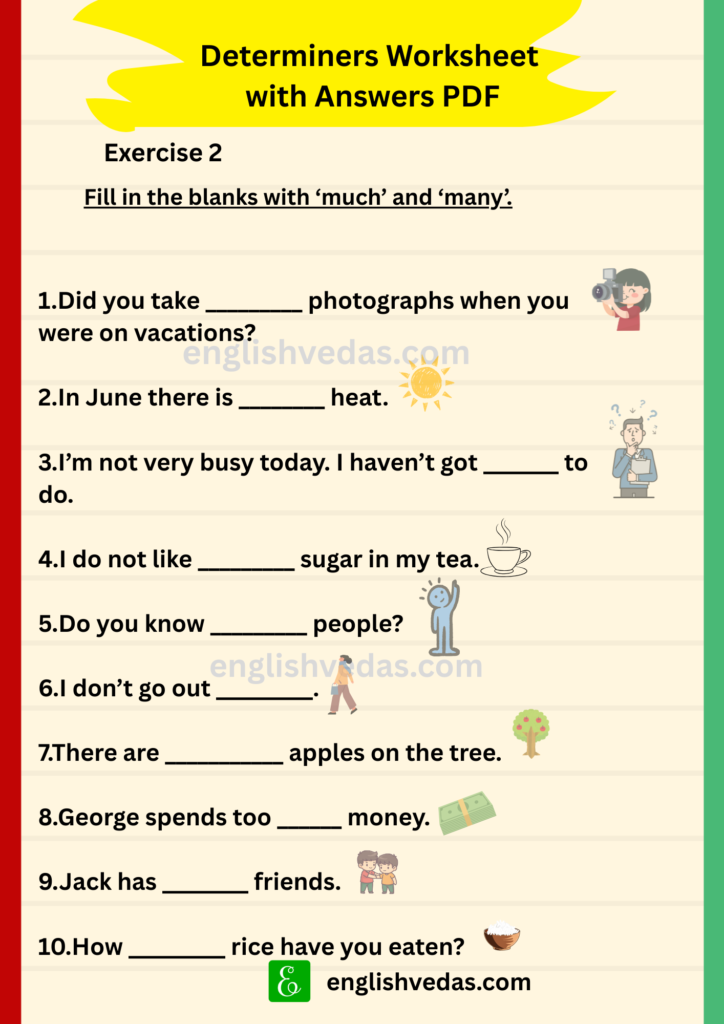
Exercise 2
Fill in the blanks with ‘much’ and ‘many’.
- Did you take _________ photographs when you were on vacations?
- In June there is ________ heat.
- I’m not very busy today. I haven’t got _______ to do.
- I do not like _________ sugar in my tea.
- Do you know _________ people?
- I don’t go out _________.
- There are ___________ apples on the tree.
- George spends too ______ money.
- Jack has ________ friends.
- How _________ rice have you eaten?
Exercise 3
Put in few or little.
- I have read _____ books.
- She showed _________ concern for her relatives.
- ________ children can keep a secret.
- The weather has been very dry recently. We’ve had _____ rain.
- There was _______ food in the refrigerator.
- We must be quick. There is ______ time.
- I lost the _______ friends I had.
- A ________ knowledge is a dangerous thing.
- He is lucky. He has ______ problems.
- Most of the town is modern. There are ________ old buildings.
Exercise 4
Fill in the blanks with each or every.
- ______ time I saw him, he was busy.
- I’ve read _______ one of these books.
- _________ player has three cards.
- There’s a train to Delhi _________ hour.
- ________ apartment has a balcony.
- Last week it rained _____ day.
- There were three pens on the table. ______ pen was a different colour.
- We had a great weekend. I enjoyed _____ minute of it.
- While he was in Goa, he came to see me _______ day.
- Five children were sitting on ______ bench.
Answers:-
Exercise 1 (some / any)
- some
- any
- any
- any
- some
- any
- some
- some
- some
- any
Exercise 2 (much / many)
- many
- much
- much
- much
- many
- much
- many
- much
- many
- much
Exercise 3 (few / little)
- few
- little
- few
- little
- little
- little
- few
- little
- few
- few
Exercise 4 (each / every)
- Every
- each
- Each
- every
- Each
- every
- Each
- every
- every
Also Read:-
- Uses of Modals for Class 5 | May, Might, Can, Could, Should & More with Examples
- Use of This, That, These, Those – 30 Example Sentences Worksheet for Class 1 (With Answers)
- Debate on Can AI Replace Teachers?|5 Points For and Against
- Debate: Are Friends Better Than Family in Today’s Modern Life?| Points For and Against 2025
- How to Use Causative Verbs in English Grammar (Have, Make, Get, Let) with Easy Examples
- 100 Simple Future Tense Example Sentences with Structure and Usage
- 20 Future Perfect Continuous Tense Example Sentences That’ll Blow Your Mind

My name is Sukhjit Kaur, and I am an English educator with 17+ years of experience helping students master grammar and writing. Through EnglishVedas.com, I simplify English grammar using examples from daily life and classrooms. I’ve been analyzing English media for 17 years to help students understand how grammar lives in the real world.