
Modals in English Grammar for Class 5 – Simple Uses and Examples
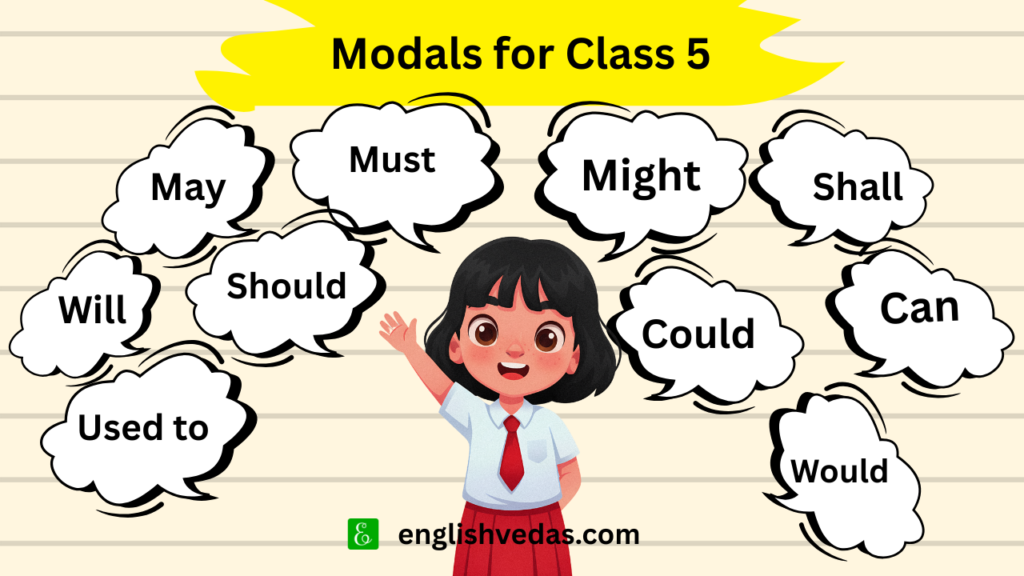
This article explains modals for Class 5. The modals are may, might, can, could, should, must, would, used to, shall, and will. The modals are explained with the help of example sentences, and it’s use in English grammar is discussed so that learners can use them in their daily conversations.
Uses of Modals
- May
- Permission: May I sit here?
- Best Wishes: May God bless you.
- To say that something is a possibility: He may be at home.
- To indicate purpose in the present: He works hard so that he may earn money for his family.
- Might
- When we want to say something about an imagination related to a past action with possibility.
- We use it to express imagination in continuity with a possibility.
- Examples: You might have left the phone in the car.
It might rain today.
Ava might not have known about it.
3. Can
- To indicate capability: I can play chess.
- To give permission: Yes, you can come in.
- It is used to express prohibition: You cannot write with a pen.
- To offer something: Can I open the door for you? Can I help you?
- 4. Could
- To express polite request: Could you open the door, please?
- For the past (yesterday/last week etc.), we use could/couldn’t.
- It indicates that the action did not take place in the past.
- Example: I could have told him the truth.
- It used for complete or incomplete past action. Example: I could speak in French because of you.
I was tired last night, but I couldn’t sleep.
- 5. Should
- It is used to express duty or obligation. Example: Archie should go to bed earlier. He always goes to bed late.
- It refers to an obligation in the past. It may imply non-performance of an action.
Example: You should have bought that dress.
It is a good book. You should read it.
- 6. Must
- It is used to express necessity. Example: John is sick. He must see a doctor.
You must follow traffic rules.
- It is used to express an action that certainly happened in the imaginary past. Example: He must have slept.
- It can also be used for an action happening in an imaginary continuous tense.
- 7. Would
- To request someone: Would you pass the salt, please?
- Conditional Past Perfect: If we had practiced mathematical problems, we would have passed the exam.
- To express a wish: I would like to buy that car.
- 8. Used to
- It indicates the past routine of a habitual nature of the subject.
Example: When I was a child, I used to like chocolate.
When I was younger, I used to play cricket.
- Negative: When I was a child, I didn’t use to like eggplant.
- It is also used to indicate discontinued action. Example: He used to write letters to his grandmother.
- Shall
- Shall is used to express the future first person. Example: I shall be an engineer next year.
- Shall is used for asking the will of the person in question form.
Example: Shall I close the door?
Where shall we study?
- Will
- We use will for the future (tomorrow/next week).
Example: At 9 o’clock tomorrow, I will be in school.
- It is used for expressing willingness.
Example: I will help you out.
- It is also used for expressing a characteristic habit.
She will talk about nothing but films.
Also Read:-
- Use of This, That, These, Those – 30 Example Sentences Worksheet for Class 1 (With Answers)
- Debate on Can AI Replace Teachers?|5 Points For and Against
- Debate: Are Friends Better Than Family in Today’s Modern Life?| Points For and Against 2025
- How to Use Causative Verbs in English Grammar (Have, Make, Get, Let) with Easy Examples
- 100 Simple Future Tense Example Sentences with Structure and Usage
- 20 Future Perfect Continuous Tense Example Sentences That’ll Blow Your Mind
- Use of as If in English Grammar with 20 Simple Example Sentences

My name is Sukhjit Kaur, and I am an English educator with 17+ years of experience helping students master grammar and writing. Through EnglishVedas.com, I simplify English grammar using examples from daily life and classrooms. I’ve been analyzing English media for 17 years to help students understand how grammar lives in the real world.