
Causative Verbs in English Grammar: Meaning, Use, Structure, Examples, and Exercise
It is important to learn causative verbs to learn English grammar. The exercise will help you understand how to use verbs in a sentence. By doing the Causative Verbs Exercise, you learn how to indicate that a person or a thing makes something happen. By practising the exercise, you learn the use of causative verbs correctly. Causative Verbs Exercise is useful for students and learners learning a language. They make it easy to understand the use of causative verbs in sentences.
Causative Verbs for English Usage
The verb that indicates that a person or thing helps to make something happen is a Causative Verb.
When a person or thing is the cause behind an action, we call it a causative verb. It shows that somebody or something is indirectly responsible for an action.
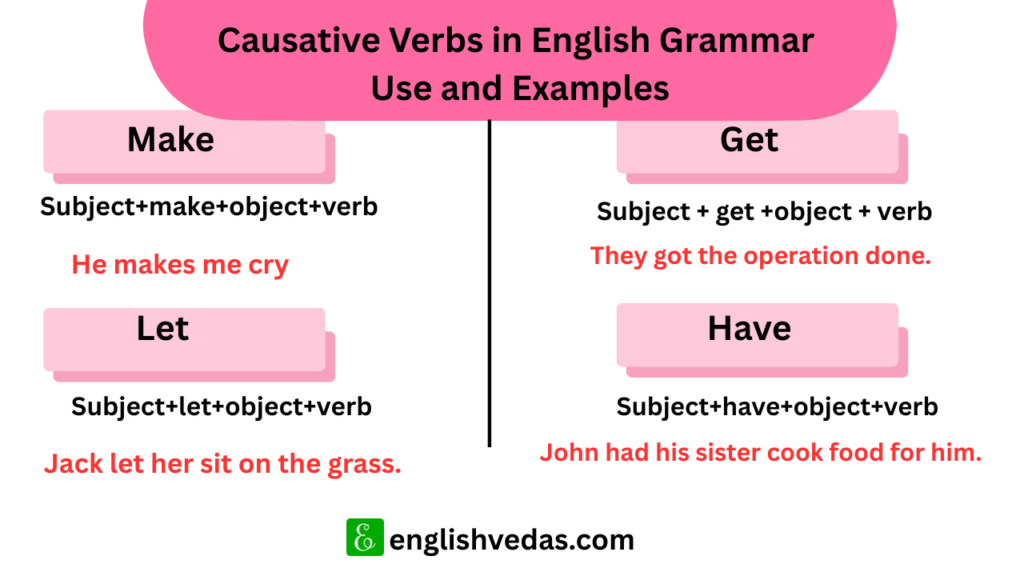
- Make
It means to force someone to take an action.
Structure
Subject +helping verb +make (tense) +object +verb
Examples:-
- He makes me cry.
- They are making him write a letter.
- He will make me run.
Structure
Object +helping Verb +made + to +verb
Examples:-
- I am made to laugh.
- Why is he being made to dance?
- I will be made to walk.
- The children are being made to study.
- They are being made to recite a poem in the class.
2. Get
When one person makes another person work on third things.
- Ravi got Jack beaten by Tom.
Structure
Subject +helping verb + get +object +verb(3rd) Subject 2 if needed
- Did you get his homework done?
- They got the operation done.
- Will you get the parcel sent tomorrow?
- Did you get the donation collected?
When a situation or thing change their nature.
- Coffee is getting cold.
- She is getting nervous.
- The weather is getting hot.
- I am getting disturbed.
3. Let
It means to permit something to happen.
For example: Let them go to the market.
Let’s play.
Let’s draw.
Structure:
Let + Object + verb+…..
- Let her sit on the grass.
- Let me sing.
- Let’s dance.
- Let Olivia speak.
- Let him go first.
4. Have
It means to authorize someone to do something.
Example: John had his sister cook food for him.
- I’ll have Maya guide you to the hall.
- Have is more formal than get.
- I had my lunch at 2.00 pm.
- They had their house renovated last year.
Exercise on Causative Verbs
Underline the causative verbs:-
- I had my brother teach me piano.
- They got their house cleaned for visitors.
- The teacher lets us leave class early on Saturdays.
- They let the dog out of the house.
- Did you get the parcel delivered?
- Mohan gets his plants watered every Sunday.
- The weather is getting cold.
- She is making her brother do the homework.
- Will you get the luggage sent tomorrow?
- Ram got Shyam beaten by Ravi.
Also Read:-
- 100 Simple Future Tense Example Sentences with Structure and Usage
- 20 Future Perfect Continuous Tense Example Sentences That’ll Blow Your Mind
- Use of as If in English Grammar with 20 Example Sentences
- Master Too and Enough: The 5-Minute English Grammar Exercise That Will Transform Your Speaking Forever
- Prefer and Would Rather Made Easy
- It and There Difference and Use in English Grammar Best

My name is Sukhjit Kaur, and I am an English educator with 17+ years of experience helping students master grammar and writing. Through EnglishVedas.com, I simplify English grammar using examples from daily life and classrooms. I’ve been analyzing English media for 17 years to help students understand how grammar lives in the real world.