
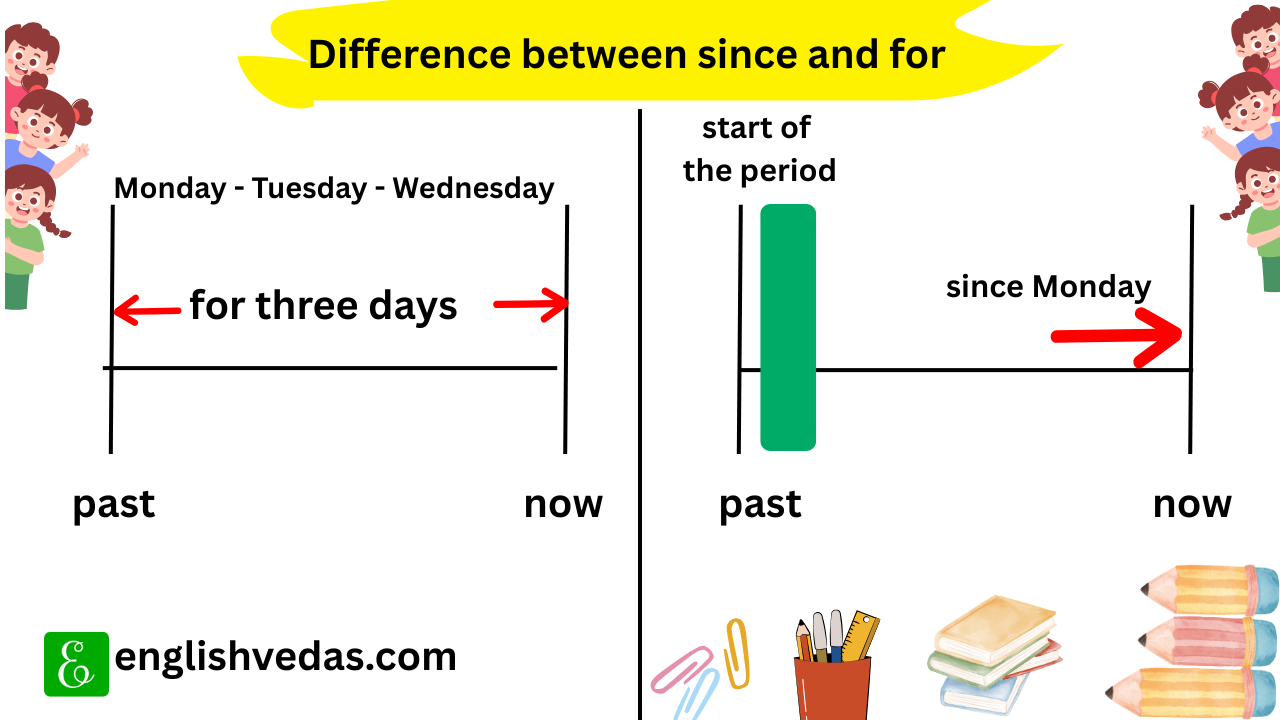
Since vs For — Quick Rule
| Use | Meaning | Examples |
|---|---|---|
| SINCE | starting point | since Monday, since 2018, since 5 p.m. |
| FOR | length/duration | for two hours, for five years, for three days |
Easy trick: Ask “When did it start?” → SINCE
Ask “How long?” → FOR
The difference between prepositions since and for in English grammar helps students to understand actions starting point of time, or the state of being. Both prepositions are used in the present perfect and present perfect continuous tenses.
The article delves into the difference, use, rules, example sentences, and exercises related to for and since.
1. What is the Difference between Since and For?
For and since are used to say how long something has been happening.
- We use “for” when we say a period of time.
Example:
- I have been reading for two hours.
- We use for + a period of time. (five days/ three years).
Example:
- He has been in Delhi for five months.
- We have been working for five hours.
- We use since the start of the period (Tuesday/ 7 O’clock, etc.).
- The preposition since is used to say about a specific point in time. Basically, it is the beginning of an action and represents the duration up to the present.
- Example:
- Tom has been in France since February. (=from February to now).
- We have been cleaning the house since 5 O’clock (=from 5 o’clock to now).
- I have lived in Canada since I was nine years old.
- The actions in the above sentences are unfinished.
- We can use: It’s a long time/ 5 years etc.) since something happened.
- Example:
- It’s been three years since I met Jack. (I haven’t met Jack for three years/ the last time I met Jack was three years ago.)
- It’s been ages since I went to the library. (We haven’t been to the library for ages.)
- The question is how long is it since………?
- How long is it since you suffered from fever? (=when did you last suffer from fever?)
- How long is it since Susan learnt German?
(=When did Susan learn German?)
- It is always used with perfect tenses.
- It refers to a specific point of time in the past.
2. What are the Rules and Structure of using Since and For? (Use in Tenses)
Rules and structure for using “for” and “since” when we refer to time:-
Structure
- Subject + has/have + past participle (verb) + for + length of time.
- Example:
- I have lived in Australia for seven years. (present perfect).
- He has been playing tennis for two hours. (present perfect continuous)
- So, this is how since and for is used in tenses.
- Time duration with “for”.
| For five years | For four weeks |
| For six days | For two hours |
| For ten months | For a long time |
Since = starting point of time of an action (when?)
Structure
- Subject +has/have +past participle (verb) +since + specific time.
- Example:
- I have been learning English since January.
- She has been waiting since 10 O’clock.
- They have lived in London since 2015.
Time duration with “since”.
| Monday | May | Friday |
| 5 o’clock | 2018 | I was nine years old |
| 16 June | Christmas | We arrived |
- It is used in present perfect tense and present perfect continuous tense.

Since vs For Examples
- Since Monday
- Since 2014
- Since 5 o’clock
- Since Christmas
- For 3 hours
- For 10 days
- For 7 years
- He has been staying in a hotel since Monday.
- John has been working in a school since 2014.
- I have been studying since 5 o’clock.
- They haven’t visited us since Christmas.
- Sita has been washing clothes for three hours.
- They have been renovating their house for 10 days.
- We have been living here for 7 years.
- I have been learning English for 6 months.
- He has been listening to music since 2 o’clock.
- My grandmother has been knitting the sweater for 5 weeks.
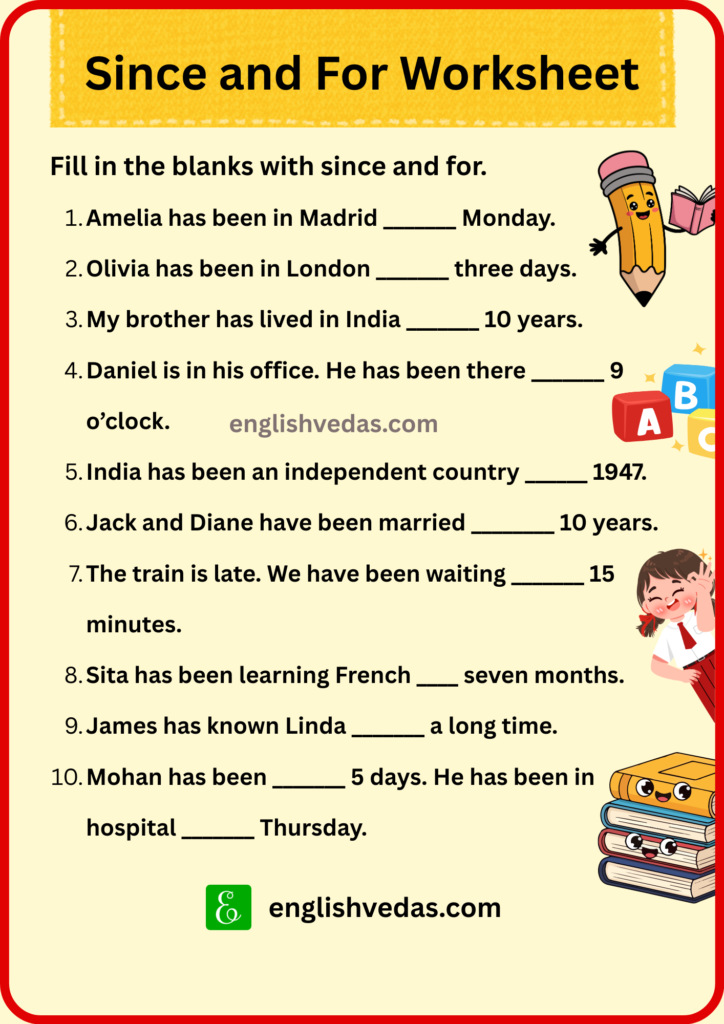
3. For and Since Exercise with Answers
Write for or since.
- Amelia has been in Madrid _______ Monday.
- Olivia has been in London _______ three days.
- My brother has lived in India _______ 10 years.
- Daniel is in his office. He has been there _______ 9 o’clock.
- India has been an independent country ______ 1947.
- Jack and Diane have been married ________ 10 years.
- The train is late. We have been waiting _______ 15 minutes.
- Sita has been learning French ____ seven months.
- James has known Linda _______ a long time.
- Mohan has been _______ 5 days. He has been in hospital _______ Thursday.
Answers:-
- Since
- For
- For
- Since
- Since
- For
- For
- For
- For
- For, since
Exercise 2
Each sentence contains a mistake. Rewrite it using since or for correctly.
- I have studied here since two hours.
- He has been writing since 5 weeks.
- They haven’t visited us for Diwali.
- We have known each other for 2015.
- George has been playing tennis for 5.00 pm.
- She has had this washing machine since 10 years.
- I haven’t been to the market since two weeks.
- They have been married since 7 years.
- She has been cleaning her house since 3 hours.
- Tina hasn’t been to school for Monday.
Answers
- I have studied here for two hours.
- He has been writing for 5 weeks.
- They haven’t visited us since Diwali.
- We have known each other since 2015.
- George has been playing tennis since 5:00 p.m.
- She has had this washing machine for 10 years.
- I haven’t been to the market for two weeks.
- They have been married for 7 years.
- She has been cleaning her house for 3 hours.
- Tina hasn’t been to school since Monday.
Common Mistakes (Since and For)
- Use of since for a period of time.
- I have been teaching in this school since ten years.❌
- have been teaching in this school for ten years.✅
Since is used for a specific point of time, for duration or a period of time use for.
2. Use of for with a starting point.
- She has been reading the book for 8 o’clock.❌
- She has been reading the book since 8 o’clock.✅
- Since is always used for the starting point of an action. For denotes how long.
- .Mixing while using them with tenses.
- I am living in Delhi since 2010.❌
- I have been living in Delhi since 2010. ✅
- Since and for are not used for the present continuous tense. They are used for the present perfect or present perfect continuous tense.
- Using both together unnecessarily.
- She has been cooking since for three hours.❌
- She has been cooking for two hours.✅
- She has been cooking since 9 am. ✅
You can use since or for in a sentence.
Frequently Asked Questions:-
1. What is the main difference between “since” and “for”?
“Since” is used to talk about the starting point of an action, while “for” is used to show the duration of time an action has continued.
2. Can you give simple examples of “since” and “for”?
Examples of since and for:
I have worked in a school since 2018.
I have worked in a school for seven years.
3. Can we use since and for with the present perfect tense?
Yes, both since and for can be used with the present perfect tense to describe an action that started in the past and is continuing till the present.
He has stayed here since Monday.
He has stayed here for three days.
4. What types of time expressions follow “since” and “for”?
We use specific points in time after “since”: since Wednesday, since 5 am, since I was 10 years old.
Use the length of time after “for”: for one hour, for two weeks, for nine years, for a long time.
5. Can “since” be used in both present perfect and the present perfect continuous tense?
Yes, since can be used for both the tenses.
For example, Rohan has been in Delhi since July. (Present Perfect- it shows that an action is completed in the present)
Vineet has been playing cricket since 9.00 am. (Present Perfect Continuous tense- it shows ongoing nature of an action)
Happy Learning!
Also Read:-
- The Best Guide to Reported Speech Exercises and Worksheets
- Must and Have to: Surprising Difference Clarity and Exercise
- Present Perfect Tense Active and Passive Voice Exercise: 50 Sentences
- Mastering Each and Every Difference Use 30 Example Sentences: Best
- Mastering the Past Perfect Continuous Tense: 30 Example Sentences and Exercises to Boost Your Grammar Skills
- Master the Difference Between Like and As in English Grammar
- Difference Between So and Such, Use and Exercises Best Explained
- Use of Present Perfect Tense in 60 Sentences: Example, Formula and Structure.
- Present Perfect Continuous Tense 50 Best Examples and Formula
- Prepositions of Place Worksheet with Answers PDF (Free Download)
- Prepositions with Adjectives: 50 Easy Sentences and Examples

My name is Sukhjit Kaur, and I am an English educator with 17+ years of experience helping students master grammar and writing. Through EnglishVedas.com, I simplify English grammar using examples from daily life and classrooms. I’ve been analyzing English media for 17 years to help students understand how grammar lives in the real world.